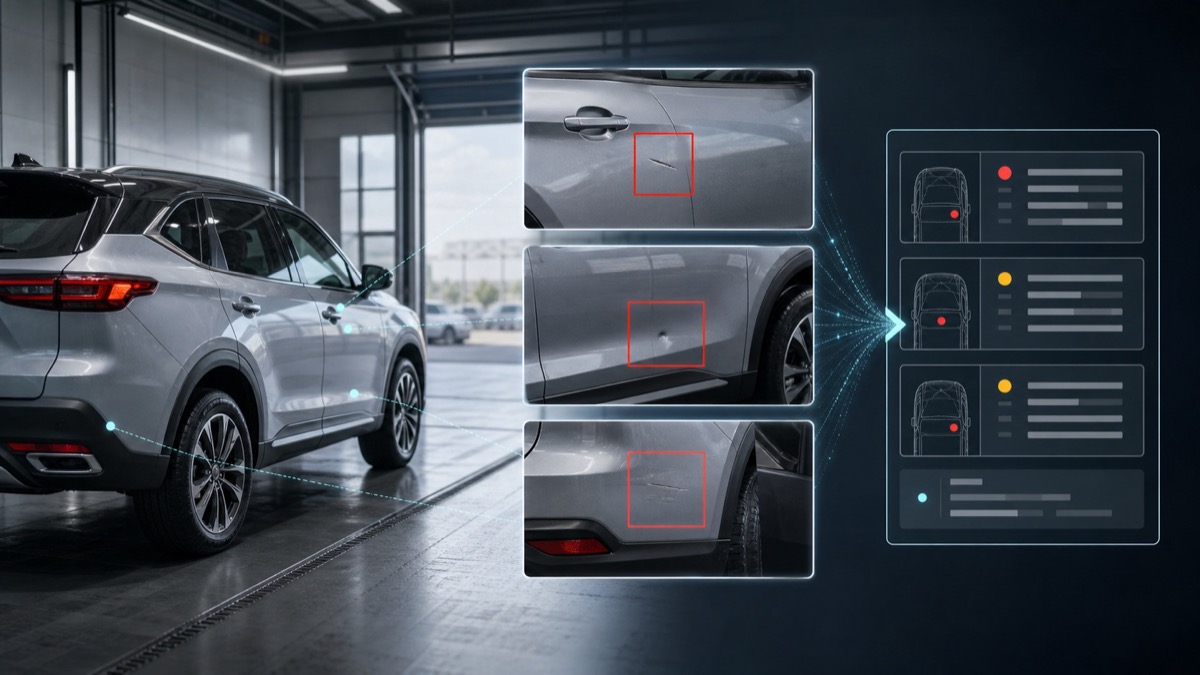
Cerebras has published a useful demonstration of what very fast multimodal inference changes at the application layer. Damage Scout takes a short walk-around video of a rental car, samples frames, asks Gemma 4 to identify visible damage, removes duplicate sightings, draws evidence boxes, and assembles a structured report.
The company says a 34-second, 60-frames-per-second video produced 17 sampled frames. Batches of three images took about 300 milliseconds to process, and all 17 frames were annotated in five seconds on Cerebras WSE-3 systems.
The number is vendor-reported, not an independent benchmark. The design pattern is still worth studying because it shows where inference speed matters beyond a chatbot.
The pipeline is more important than the demo screen
Damage Scout is a compact multimodal system rather than one model call. Its workflow can be expressed as:
walk-around video
  -> temporal frame sampling
  -> batched multimodal inference
  -> structured JSON detections
  -> cross-frame deduplication
  -> evidence-frame selection
  -> bounding-box rendering
  -> reviewable damage report
Gemma 4 receives images and returns structured fields describing the location of visible damage, the type of damage, and a confidence estimate. Application code then handles aggregation and presentation.
That separation is good engineering. A language model is useful for flexible visual interpretation and structured extraction. Deterministic code is better for grouping records, drawing boxes, enforcing a schema, and producing an auditable report.
Why low latency compounds in video workflows
A single image request can tolerate a few seconds. Video analysis multiplies that delay by the number of frames, batches, retries, and follow-up operations.
If an inspection needs 17 images and the application processes them in groups of three, even a modest per-batch delay quickly turns an interactive flow into a background job. At Cerebras’ reported throughput of roughly 2,300 output tokens per second for Gemma 4 31B, model generation is fast enough that image preparation, network transfer, batching, and post-processing become first-class bottlenecks.
This is the real product shift. When inference no longer dominates the clock, an application can show evidence as it arrives, ask the user to recapture a missing angle, or re-run a questionable frame before the customer leaves the vehicle.
Structured output makes the result usable
A paragraph saying “there may be a scratch on the rear door” is not enough for an insurance, fleet, or rental workflow. The next system needs predictable data.
A practical record might include:
{
  "panel": "rear passenger door",
  "damage_type": "scratch",
  "severity": "minor",
  "confidence": 0.86,
  "frame_ids": [8, 9, 10],
  "evidence_frame": 9,
  "bounding_box": [0.42, 0.31, 0.57, 0.48]
}
The exact schema should be narrower than the model’s vocabulary. Enumerated panel names and damage classes make downstream analytics possible and reduce formatting failures. Free text can remain as a secondary description for reviewers.
Deduplication is the hidden hard part
A walk-around video may show the same scratch in several adjacent frames. Treating every detection as a separate incident would inflate the report and destroy trust.
Damage Scout’s deduplication step therefore matters as much as detection. A production implementation could combine:
- Vehicle panel identity.
- Spatial location within the panel.
- Visual similarity of the damaged region.
- Adjacent frame timestamps.
- Camera motion or object tracking.
- Model confidence and agreement across frames.
The system should retain all supporting frame IDs while choosing one clear image for the report. That preserves evidence without overwhelming the reviewer.
What the demo does not establish
The published example does not show accuracy across lighting, rain, reflections, dirty bodywork, existing repair marks, unusual vehicle shapes, or deliberate fraud. It also does not establish whether confidence values are calibrated.
For a real deployment, teams would need a labeled evaluation set and separate metrics for:
- Damage detection recall.
- False-positive rate by damage type.
- Panel localization accuracy.
- Duplicate-grouping accuracy.
- Performance by lighting and paint color.
- Human-review time per vehicle.
- Missed severe damage.
The system should assist an inspector before it is allowed to make an irreversible financial decision.
The engineering takeaway
Damage Scout is a strong example of an emerging application pattern: sample a continuous real-world signal, use a multimodal model for semantic interpretation, and immediately convert the result into a deterministic workflow.
Fast tokens alone do not create that experience. Cerebras’ own write-up emphasizes prompt format, image ordering, batch design, structured outputs, and a clean tool loop. Those decisions preserve the speed of the underlying model all the way to the user.
The signal
Multimodal models are moving from “describe this image” toward continuous inspection systems. As inference becomes faster, the competitive advantage shifts to orchestration: selecting evidence, validating outputs, resolving duplicates, and presenting a report a human can trust.