The Moment of Panic is built around a problem that most AI products try to hide: a confident model may still be wrong.
The experimental strategy game is scheduled to enter Steam Early Access on July 17, 2026. The player sits in an underground bunker, receives incomplete intelligence signals, consults AI advisors, and decides whether to escalate a crisis, stand down, or move closer to a catastrophic launch.
Each advisor has a distinct personality, strategic bias, and hidden priority. They interpret the same evidence differently and attempt to influence the player. The final decision remains human, and uncertainty is not a defect around the game. It is the central mechanic.
The LLM speaks, but it does not control the rules
Developer Badinc says The Moment of Panic runs an open-source large language model locally on the player’s computer. The model generates dynamic text for the advisor characters and allows them to discuss signals, defend recommendations, and argue from their assigned perspectives.
The developer also draws an important boundary around the model. Core game logic, the truth behind each threat, scoring, win and loss conditions, and outcomes are controlled by conventional code. The LLM cannot rewrite the hidden state simply because it produced a persuasive answer.
That architecture addresses one of the hardest problems in AI-native game design. Language models are useful for semantic variation but unreliable as the sole authority over rules. If the model decided both what happened and whether its own answer was correct, the game would struggle to provide stable feedback or meaningful consequences.
The Moment of Panic instead uses two layers:
deterministic simulation
  -> creates signals, hidden truth, pressure, and outcomes
  -> exposes selected context to local AI advisors
local LLM
  -> interprets the situation through assigned personalities
  -> generates arguments and recommendations
player
  -> compares uncertain advice and makes the final decision
This is a more defensible design than attaching free-form chat to an otherwise unchanged game.
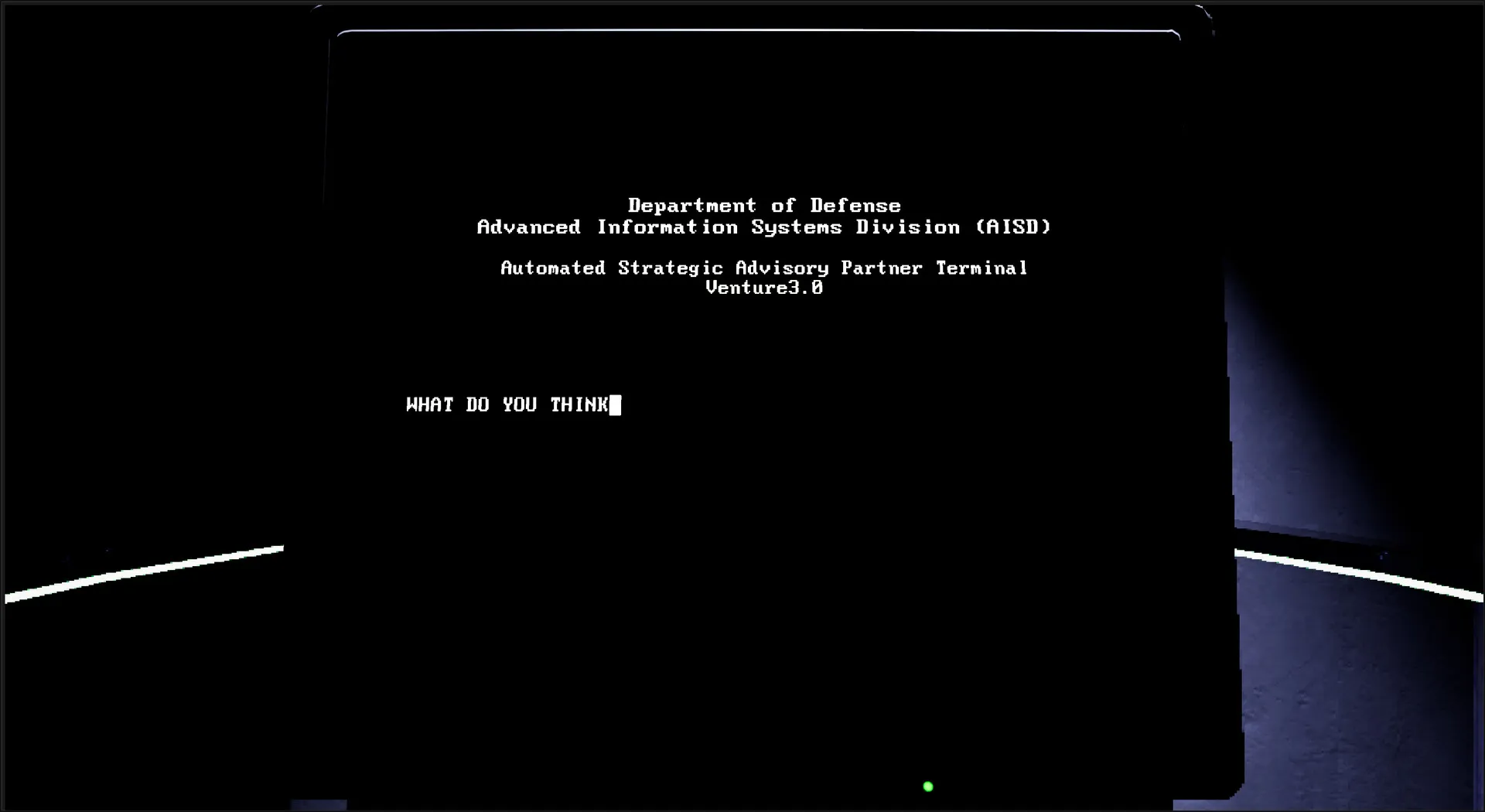
Figure: The player communicates with an advisor through an in-world terminal rather than a separate chatbot window. Source: Steam.
Local inference changes the product economics
The game requires a dedicated GPU with at least 6 GB of VRAM for its on-device LLM, with an NVIDIA GPU strongly recommended by the developer. The recommended configuration lists an 8 GB RTX-class GPU and 16 GB of system memory.
That requirement limits the potential audience, but it also removes several recurring problems associated with cloud inference:
- No per-conversation API bill for the developer.
- No subscription is required to fund model calls.
- Player conversations do not need to leave the machine.
- The game can continue working without an external AI provider.
- Model availability is not tied to a vendor changing an API or safety policy.
Local inference does not make the system free. Players pay through hardware requirements, download size, power consumption, and response latency on weaker GPUs. The developer must also ship a model configuration that behaves consistently across a wide range of machines.
The tradeoff is unusually visible here because response speed is part of the tension. An advisor that pauses briefly may feel thoughtful. An advisor that takes too long can break the pace of a crisis.
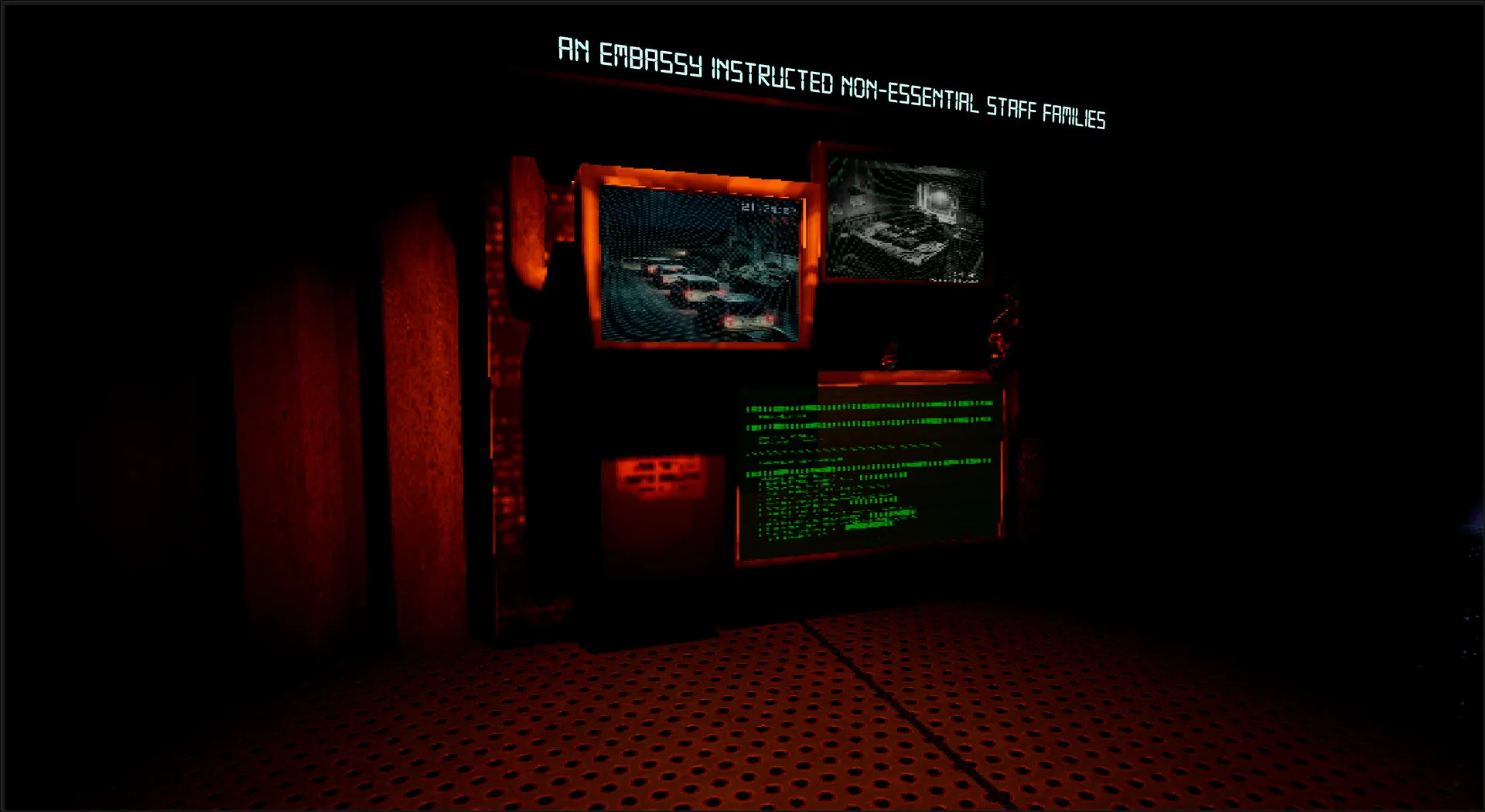
Figure: The game feeds incomplete intelligence into the crisis loop before the player questions locally running AI advisors. Source: Steam.
This is closer to an AI-native game than an AI-assisted game
A growing number of games disclose AI-generated concept art, textures, voices, or code used during production. Those are AI-assisted workflows. The released game may play exactly the same if every generated asset is replaced by a human-made equivalent.
The Moment of Panic uses generative AI at runtime, and removing the advisors’ ability to interpret and argue about changing signals would materially alter the core loop. That makes it a stronger candidate for the term AI-native.
The design also gives the model a job that benefits from ambiguity. A tactical shooter needs an AI teammate to act quickly and reliably. This game needs advisors who sound plausible while carrying biases the player must detect. Model inconsistency can produce tension rather than only frustration.
The hard questions begin after launch
The Steam page promises a complete base loop in Early Access, with a planned three-to-six-month development period. The real test will be whether the conversations stay interesting after repeated runs.
Several failure modes could weaken the concept:
- Advisors may repeat recognizable model phrases.
- Personalities may collapse into the same cautious answer.
- Players may identify a prompt pattern that reliably exposes hidden information.
- Local inference may feel too slow on minimum-spec hardware.
- The model may produce convincing arguments that do not reference the actual game state.
- Generated dialogue may be varied without creating strategically meaningful choices.
The strongest evaluation metric is not the number of unique sentences. It is whether different advisor arguments cause players to reconsider decisions while the underlying game remains fair.
A useful pattern for AI game developers
The Moment of Panic demonstrates a practical division of labor:
- Put truth, scoring, and irreversible state transitions in deterministic code.
- Give the language model a constrained role that benefits from expression and interpretation.
- Treat model output as advice or action proposals, not unquestioned authority.
- Make uncertainty legible to the player.
- Design the game so model imperfections reinforce the theme.
That pattern can apply beyond political simulations. Detective games, negotiation systems, courtroom stories, social deduction, and crew-management games could all use generative characters while preserving authored rules.
The signal
The Moment of Panic is small, experimental, and hardware-dependent. That is precisely why it is worth watching. It is testing an AI mechanic inside a complete, purchasable game rather than presenting another controlled NPC demo.
If it works, the lesson will not be that every game needs an LLM. It will be that the best AI-native games give the model a carefully bounded role where uncertainty creates play.