The most successful use of AI in games is not the feature that writes dialogue, generates quests, or replaces concept art.
It is the technology quietly reconstructing pixels and generating frames between player inputs.
Generative content remains culturally and operationally contested. GDC’s 2026 industry survey found that 52% of respondents view generative AI negatively. Neural rendering, meanwhile, is moving deeper into graphics hardware, APIs, engines, and released games.
NVIDIA said at CES 2026 that more than 250 games and applications supported DLSS Multi Frame Generation and that DLSS 4.5 Super Resolution could improve image quality in more than 400. Microsoft now describes machine learning as foundational to real-time graphics and is adding lower-level DirectX support for neural workloads inside the rendering pipeline.
These are different forms of AI. Their different reception explains what production adoption looks like when a model is narrow, measurable, and subordinate to the product.
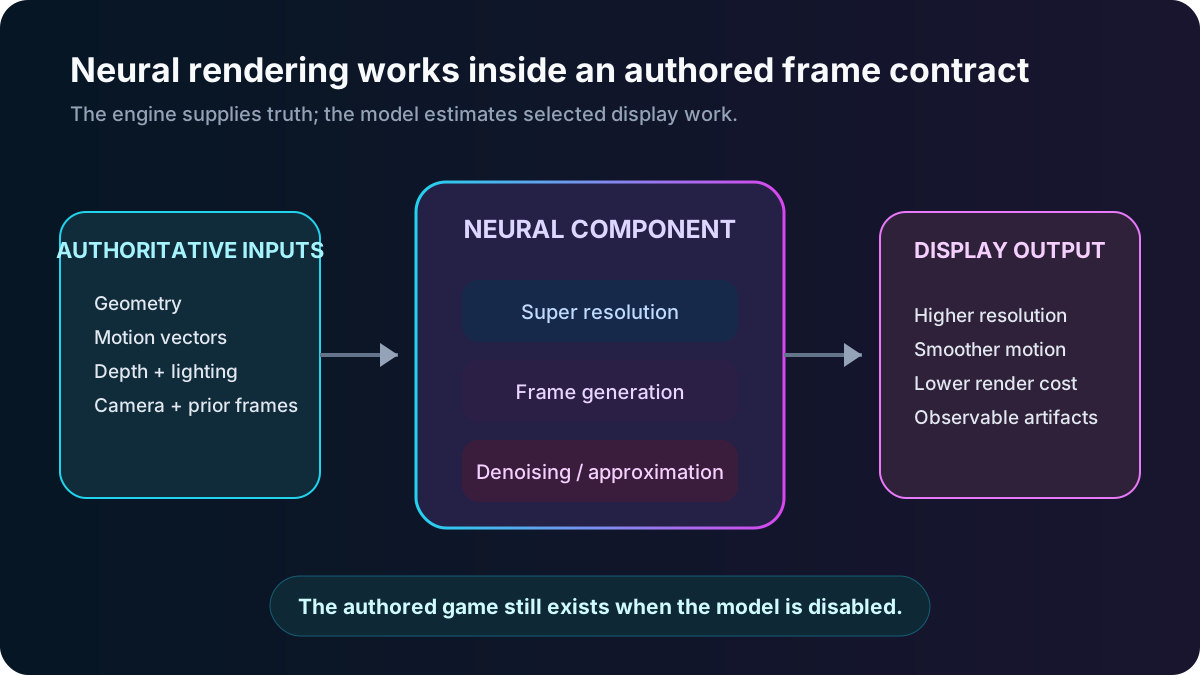
Figure: The model estimates selected rendering work from trusted engine inputs; it does not become the authority for the game world.
Neural rendering solves a constrained problem
A game engine begins with a known scene: geometry, materials, motion vectors, depth, lighting, camera state, and previously rendered frames. Neural rendering uses some of that information to reconstruct a higher-resolution image, estimate missing detail, generate intermediate frames, denoise a ray-traced result, or approximate an expensive shading operation.
The output space is large, but the contract is narrow. The system is not asked to decide who the hero is or what a castle should mean. It is asked to produce a frame that remains faithful to authored scene data while meeting a performance target.
This makes failure easier to define.
A reconstructed image may shimmer, blur small text, produce ghosting, or lose fine geometry. An intermediate frame may introduce artifacts around fast motion. Frame generation may increase displayed frame rate without reducing the latency of the underlying simulation.
Those failures are serious, but they are observable. Reviewers can capture the same scene, compare modes, measure latency and frame time, and turn the feature off.
The central creative artifact—the game—continues to exist without the model.
Adoption is visible in the graphics stack
NVIDIA’s CES 2026 announcement introduced a second-generation transformer model for DLSS 4.5 Super Resolution and a dynamic version of Multi Frame Generation intended to adjust the frame multiplier toward a target refresh rate.
Vendor adoption numbers should be read carefully. A list of supported games does not reveal how many players enable the feature, which quality mode they choose, or whether every implementation performs equally well. A generated frame is also not equivalent to a fully simulated frame.
The broader infrastructure movement is harder to dismiss.
Microsoft introduced Cooperative Vector support in Shader Model 6.9 so small neural workloads could run through hardware-accelerated vector-matrix operations inside traditional shader code. In March 2026, the company announced DX Linear Algebra, a model-level path intended to help developers compile and schedule machine-learning graphs as GPU workloads.
Microsoft is working with AMD, Intel, NVIDIA, and Qualcomm on the DirectX direction. The significance is not one upscaler winning. It is machine learning becoming a first-class graphics primitive rather than a vendor-specific postprocessing experiment.
That creates a path for neural texture compression, material approximation, denoising, geometry processing, character rendering, and other techniques that can run alongside conventional shaders.
Rendering AI leaves authorship intact
The public argument around generated game content is partly an authorship argument.
Players want to know whether artists, writers, actors, and designers made the work they are purchasing. Developers worry about training data, labor displacement, style imitation, and generated output that cannot be revised coherently. Platforms need disclosure and guardrails when AI-produced text, images, audio, or localization enter the product.
Neural rendering changes the final image without normally claiming to invent the underlying world.
The level artist still places the corridor. The lighting team still chooses the mood. The animator still creates the motion. The graphics programmer still defines the rendering path. A super-resolution model estimates how the authored low-resolution frame should appear at a higher resolution.
That distinction is not absolute. Future neural materials or generated character details may move closer to content creation. Training data and proprietary dependencies still matter. Aggressive reconstruction can alter the intended image.
But the creative chain remains legible. The model performs a bounded transformation inside a pipeline controlled by the studio.
The user can compare the claim with the result
AI products are easiest to trust when the user can test the promise.
A player can toggle super resolution, inspect image quality, watch the frame counter, and decide whether the trade-off is acceptable. Reviewers can publish side-by-side captures and latency measurements. Developers can profile GPU cost and integrate quality settings.
Generated narrative is harder to evaluate. A studio may claim that an AI character creates infinite replayability, but players cannot easily measure consistency across all conversations. A model can produce fluent dialogue while contradicting world state, breaking tone, or creating moderation problems that emerge only after release.
Neural rendering does not eliminate subjective judgment, but it gives the debate shared evidence:
- Native frame time and reconstructed frame time.
- Internal and output resolution.
- Simulation rate and displayed frame rate.
- Input latency.
- Temporal stability during motion.
- Artifact frequency in known stress scenes.
- GPU memory and hardware requirements.
The feature can be tuned against an explicit quality and performance budget.
Generated frames still require honest accounting
The success of neural rendering should not turn every marketing number into an equivalent measure of performance.
Multi Frame Generation inserts predicted frames between conventionally rendered frames. The displayed frame rate can rise sharply, but player input is still sampled and simulated by the base game loop. NVIDIA Reflex and related latency techniques can reduce delay elsewhere in the pipeline, but generated frames do not create new simulation steps.
A useful benchmark should therefore report:
- The base rendered frame rate before frame generation.
- The displayed frame rate after generation.
- End-to-end input latency.
- The super-resolution mode and internal resolution.
- Image-quality artifacts in motion, interface elements, particles, and fine geometry.
- Frame pacing rather than an average alone.
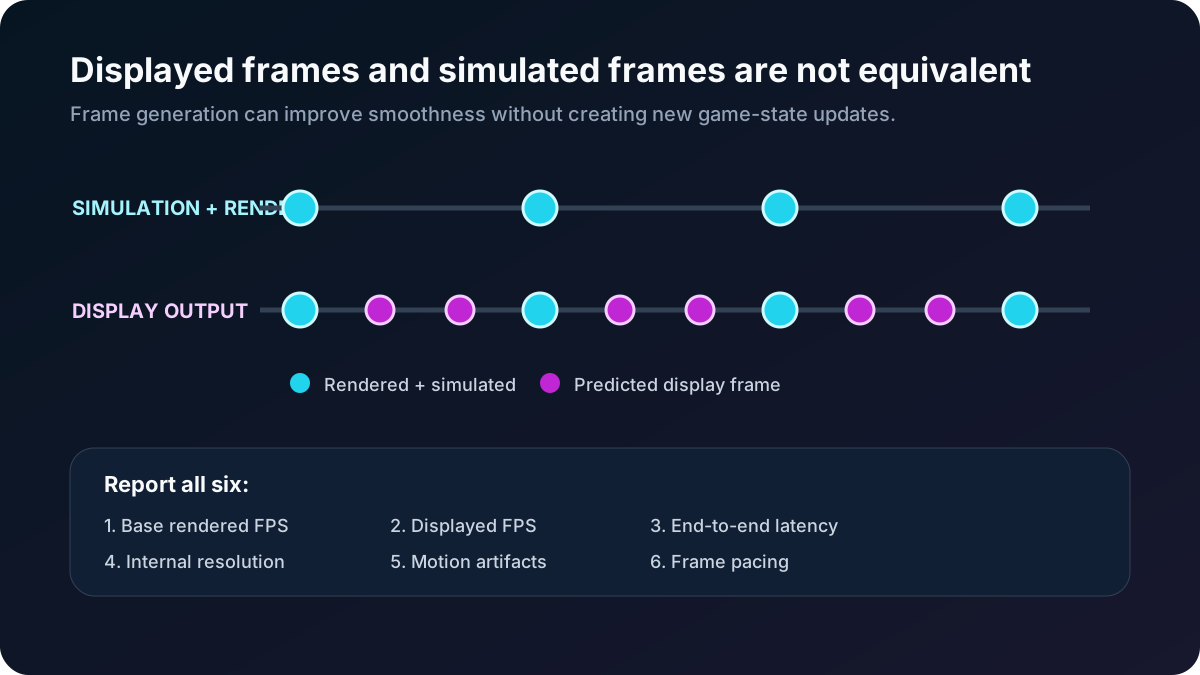
Figure: Generated display frames can improve perceived motion, but they do not add equivalent simulation or input updates.
A game displaying 180 frames per second from a 45-frame simulation does not respond like a native 180-frame simulation. It may still look substantially smoother and feel better than the baseline. Both statements can be true.
The same precision should apply to neural rendering generally. “AI-powered graphics” is a category, not a result.
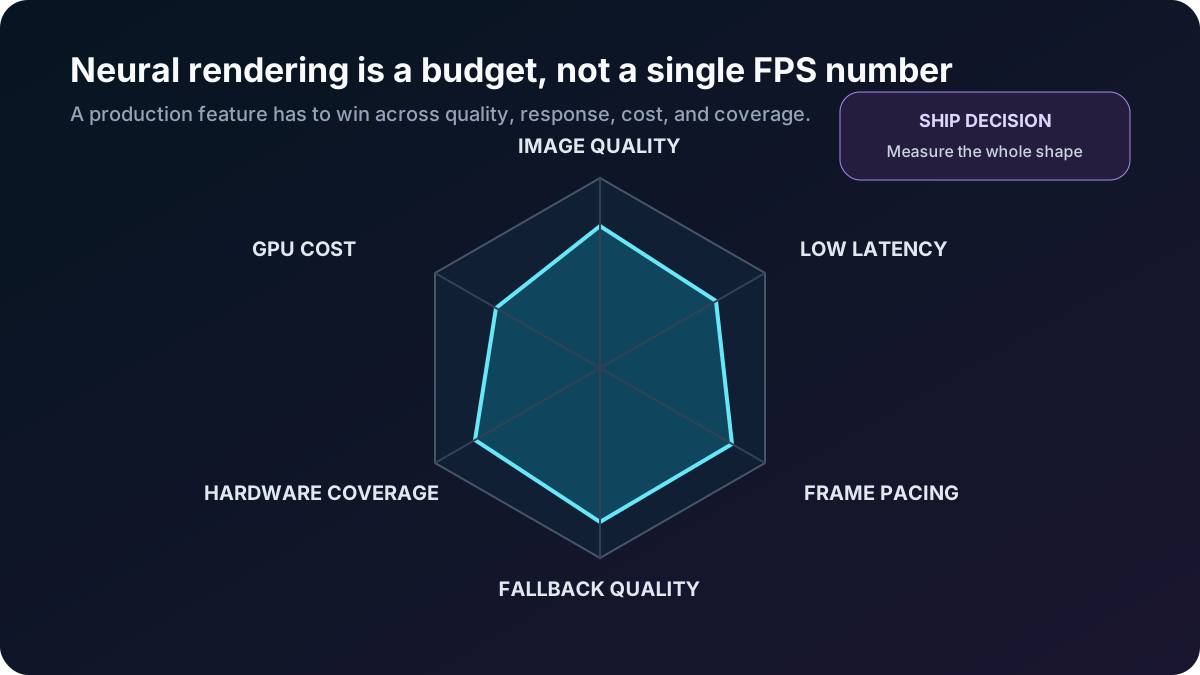
Figure: A higher displayed frame rate is useful only when image quality, latency, frame pacing, hardware coverage, GPU cost, and fallback quality stay within budget.
Bounded AI earns adoption differently
Neural rendering offers a useful framework for evaluating other AI features in games.
The input is authoritative
The engine provides trusted geometry, motion, depth, and timing data. The model does not invent the canonical game state.
The output has a narrow job
The system improves or completes a frame. It does not receive broad permission to change progression, economy, dialogue, or player inventory.
Failure is observable
Artifacts can be captured, compared, and profiled. The feature does not need a psychological interpretation of whether the model remained “in character.”
The feature is reversible
Players can usually change quality settings or disable the technique. The game can continue through a conventional rendering path.
Value is measured at the point of use
The player sees image quality and motion; the studio sees performance and hardware coverage. The benefit does not depend only on a projected reduction in labor.
This framework does not guarantee that a feature is good. It explains why one kind of AI can become infrastructure while another remains a cultural fight.
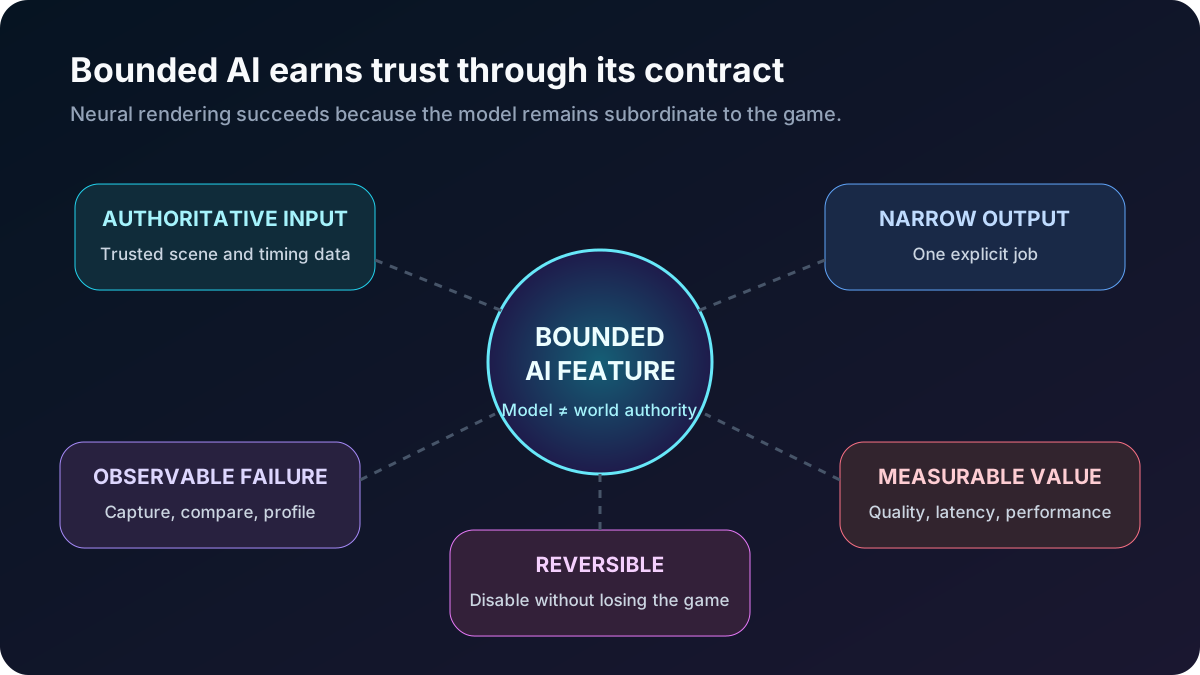
Figure: Authoritative inputs, narrow outputs, observable failures, reversibility, and measurable value make an AI feature easier to trust.
The graphics pipeline is becoming hybrid
Traditional rendering will not disappear. Rasterization, ray tracing, authored assets, simulation, and deterministic shaders remain the foundation of current games.
The likely future is a hybrid pipeline in which neural components reconstruct, compress, denoise, approximate, and generate selected parts of the frame. The engine will choose which tasks demand exact computation and which can tolerate a learned estimate.
That resembles the strongest architecture for AI characters and generated worlds. A model handles variation where uncertainty creates value. Deterministic systems retain authority where the game must remain true.
The game industry’s AI debate often asks whether developers are “for” or “against” the technology. Neural rendering exposes the weakness of that question.
Game developers have already adopted AI when it behaves like a tool: constrained by inputs, judged by output, replaceable when it fails, and measurable against the experience it promises to improve.
The biggest AI gaming success is not a machine becoming the author. It is a machine becoming one more component in the renderer.
That distinction also clarifies why studios can reject generated assets while embracing performance technology. The GTA 6 handcrafted-world strategy protects authorship, while the broader AI RPG quality test shows how quickly open-ended generation becomes a consistency problem.