The best genre for generative game characters is not necessarily the one with the most dialogue. It is the one where remembering the player’s journey can change what the next encounter means.
That makes the role-playing game the decisive test for AI-native characters. An RPG can turn remembered promises, rivalries, discoveries, and failures into new dialogue and quests. If those memories persist coherently, the player can experience something closer to a personal adventure than a branching script.
The language model is only one component. A fluent NPC placed in an unresponsive world can feel more artificial than a carefully authored character. The voice improvises, but the face repeats one animation. The companion recalls a battle, but the quest log does not. The player makes a life-changing choice, but the town resets to its default state.
That mismatch creates a behavioral uncanny valley: the character sounds human enough to raise expectations that the rest of the game cannot satisfy.
Not every game becomes better with a language model
A Forbes BrandVoice overview of AI in games separates several uses that are often collapsed into one trend: NPC behavior, dynamic difficulty, procedural generation, development tools, testing, and neural rendering.
NYU game researcher Julian Togelius makes a useful genre distinction in that article. Adding sophisticated conversational intelligence to the monsters in a fast 1990s-style shooter may not materially improve the experience. The player’s relationship to those enemies is too brief, and the core loop rewards immediate readable behavior.
RPGs create the opposite conditions. Players spend dozens of hours with companions, revisit locations, build reputations, and expect earlier decisions to matter. Dialogue, memory, and world simulation can compound over time. The value is not that an NPC can say infinitely many sentences. It is that the character can respond to a history that belongs to this playthrough.
This is why visually rich open worlds such as Grand Theft Auto or Where Winds Meet are easy to imagine as future AI-character platforms. That is a design observation, not a claim that either game currently ships the system described here. Their detailed environments and long-form interactions set a high bar: generative behavior would need to match the production quality of the surrounding world.
Current prototypes already reveal the correct split
KRAFTON’s PUBG Ally is not an RPG companion, but its architecture demonstrates an important production rule. The system uses on-device speech recognition, a 2B-parameter small language model, and text-to-speech, while separating fast combat reactions from slower language reasoning.

Figure: PUBG Ally uses NVIDIA ACE to combine voice interaction with an AI-controlled teammate. Source: NVIDIA and KRAFTON.
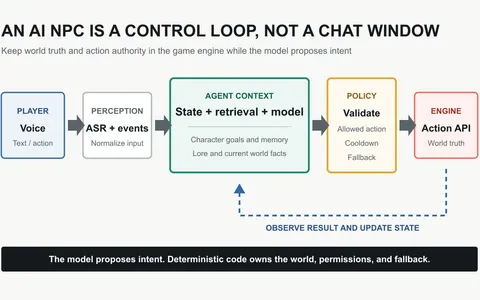
Immediate movement and combat behavior stay in a behavior tree. The language model handles contextual understanding and conversation. That division prevents an elegant sentence from delaying a life-or-death action and keeps game-critical behavior predictable.
Ally also separates memory by timescale. Short-term memory covers recent speech and current-match events. Long-term memory carries player names, preferred weapons, favorite drop locations, and notable prior matches across sessions. KRAFTON says playtesters noticed when the companion remembered a requested weapon in a later match.
Ubisoft’s NEO NPC prototype explores the narrative side of the same problem. It combines an Inworld language model with NVIDIA Audio2Face, while writers define a character’s personality, background, conversational style, and place in the scene.
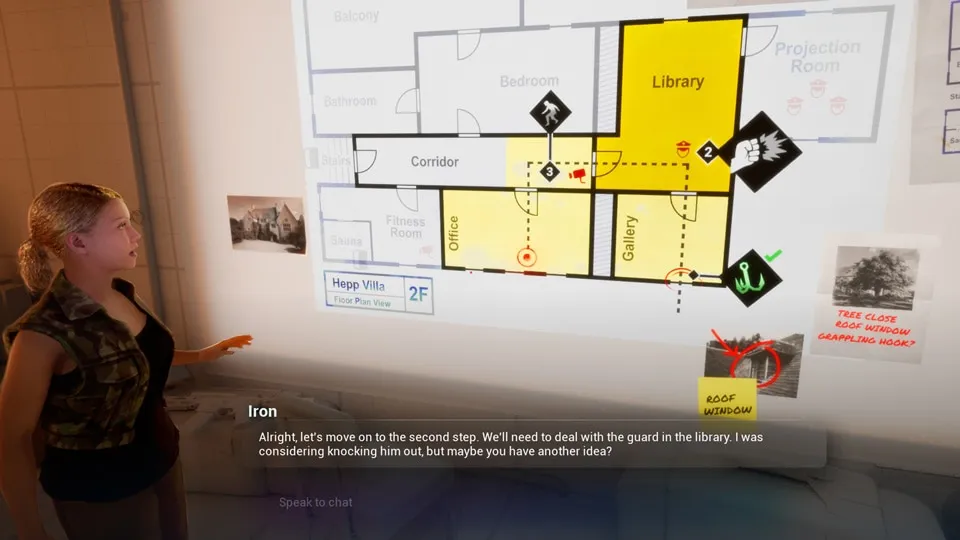
Figure: Ubisoft’s NEO NPC prototype lets a player discuss a plan with a generative character while preserving authored context. Source: Ubisoft.
Ubisoft explicitly describes NEO NPC as a prototype. The useful lesson is not that unscripted NPCs are solved. It is that generative dialogue still requires authored characterization, situation boundaries, animation, and a controlled game objective.
The memory system is the actual RPG feature
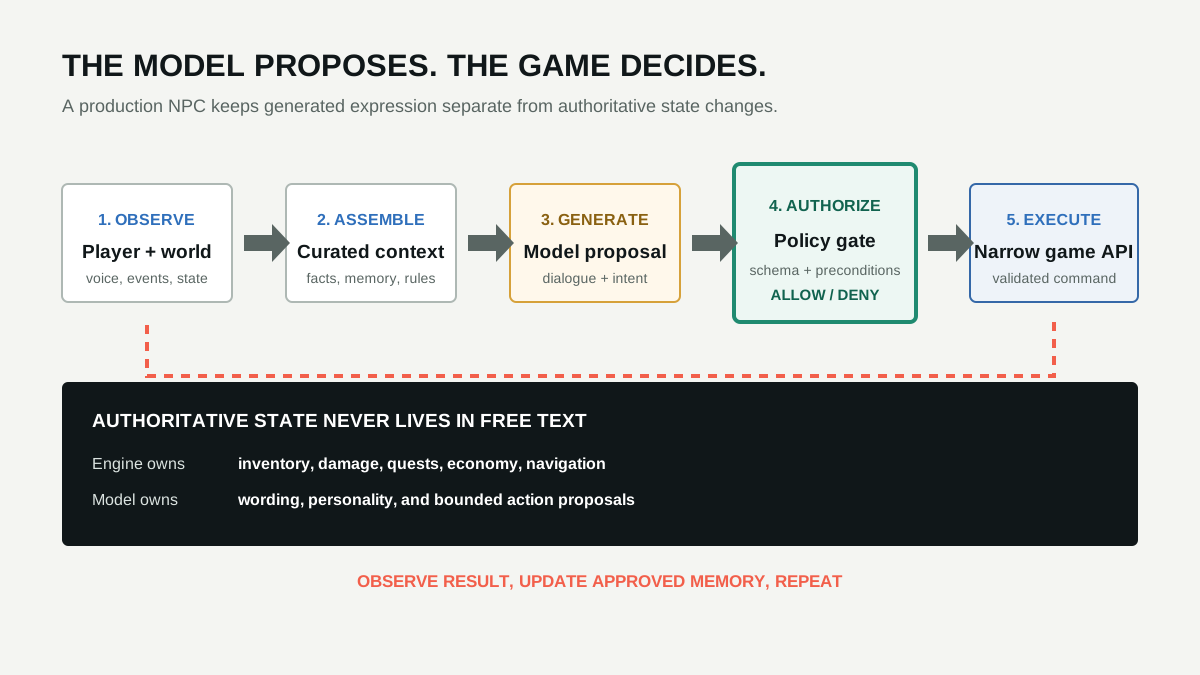
Figure: The model proposes dialogue and bounded intent while deterministic game code owns authorization, execution, and persistent state. Yield Signal Daily editorial diagram.
Raw chat history is not enough. It grows without bound, mixes important events with disposable conversation, and lets a probabilistic summary become the only record of what happened.
An RPG companion needs several memory layers:
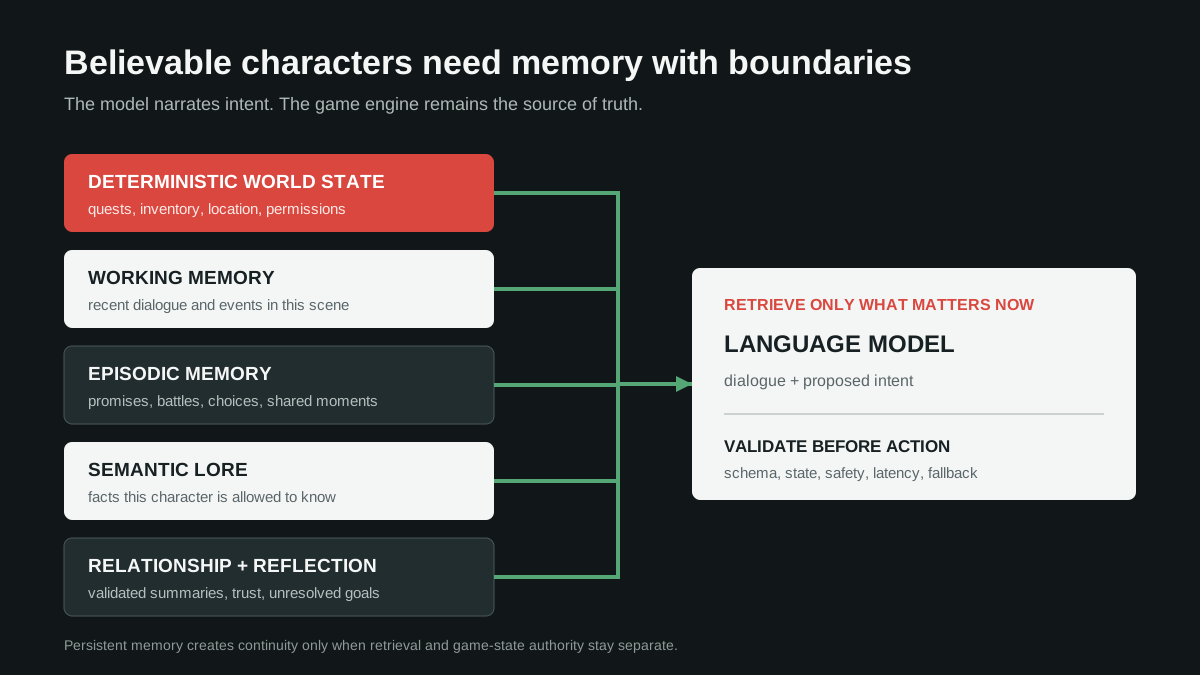
Figure: The engine owns canonical facts while the model receives a selective view of working, episodic, semantic, and relationship memory.
Deterministic world state stores facts that must remain true: quest stages, inventory, location, faction status, deaths, permissions, and completed choices. The game engine owns this layer.
Working memory represents the immediate scene: recent dialogue, visible threats, the current objective, and who is present. Most of it can expire quickly.
Episodic memory stores selected shared events with provenance. A companion may remember that the player abandoned a village, kept a promise, or gave away a valuable item. Each event should point back to engine-confirmed state.
Semantic memory contains lore the character is allowed to know. Retrieval must respect identity, location, chronology, and secrets; a village blacksmith should not suddenly possess the villain’s hidden plan.
Relationship and reflection memory turns repeated events into validated summaries such as growing trust, unresolved resentment, or a shared goal. The 2023 Generative Agents paper found that observation, planning, and reflection each contributed to believable simulated behavior. A game still needs stricter validation because these memories can affect progression.
The model retrieves only what matters for the current decision. It proposes dialogue and intent. The engine validates the action, updates canonical state, and decides whether the result deserves a durable memory.
Art direction determines whether the illusion holds
Adding a stronger model does not automatically make a character feel alive. The visual and interaction vocabulary must be able to express what the model says.
If an NPC generates nuanced grief but has one cheerful idle pose, fluency exposes the production gap. If the character claims to be afraid but walks directly into danger, the language and behavior contradict each other. If a procedural quest describes a collapsed bridge that remains intact in the world, generation breaks spatial trust.
Pixel art is not inherently incompatible with AI characters. A deliberately stylized game can support expressive systems through portraits, timing, sound, animation states, and concise writing. The problem appears when the sophistication of generated behavior exceeds the presentation system’s ability to communicate it.
A production team should define an expression budget for every character:
| Generated intent | Required game support |
|---|---|
| changes emotional tone | matching voice direction, portrait, or animation state |
| remembers a past event | inspectable journal entry or relationship cue |
| proposes a new quest | validated objective, location, reward, and completion rule |
| reacts to danger | immediate deterministic movement or combat behavior |
| changes a relationship | bounded state update with narrative consequences |
The richer the generated language, the more states the art, audio, quest, and animation systems must expose. Good art direction can intentionally narrow the model’s output so every supported emotion and action has a convincing presentation.
Dynamic quests need authored grammar, not infinite freedom
The fantasy is a companion who creates a unique quest from any conversation. The production version should be more structured.
Let the model choose and personalize from authored quest primitives: target, motive, location, obstacle, ally, reward class, and consequence. The engine verifies that required entities exist, navigation is possible, rewards are legal, and the quest does not contradict the main story. Dialogue can vary freely inside those boundaries.
This approach still creates meaningful diversity. A companion can connect a new objective to a remembered loss, select a route based on the player’s prior behavior, and change the emotional framing of a familiar activity. The quest remains testable because its mechanics come from known components.
Our AI NPC architecture guide describes the broader control loop, while the local simulation game AI Society shows why persistent model-driven societies are becoming accessible on consumer hardware. The current NVIDIA ACE stack demonstrates how speech, retrieval, and local inference can fit into a real-time engine.
RPGs are the proving ground
RPGs offer the clearest path from generative dialogue to a genuinely different game. Their long relationships, world state, and quest structure give memory a reason to exist. When a companion remembers a promise and the world reacts consistently, the player receives a new kind of authorship over the adventure.
The risk is building a brilliant conversational layer on top of a world that cannot respond. Avoiding that uncanny valley requires a hybrid design: behavior trees for reflexes, deterministic systems for truth, a language model for expression and intent, selective memory for continuity, and art direction that can display the resulting states.
The breakthrough will not be an NPC that can talk forever. It will be an NPC that remembers the right thing, expresses it convincingly, and changes the next playable moment without breaking the game.