World models can now generate scenes that respond to a player’s movement. That does not make them game engines.
Google’s Project Genie creates explorable environments from text and images. Microsoft’s Muse predicts game frames and controller actions. Roblox is generating functional objects with separately controllable parts. NVIDIA and Epic Games researchers are organizing work around controllable generative graphics.
These systems are converging on a new medium: interactive output that is generated rather than fully rendered from a manually authored world.
The difficult step is no longer proving that a model can produce a moving scene. It is giving a designer authority over what remains true, a programmer access to inspectable state, and a player a world that can survive more than a compelling demonstration.
A game engine is not the image on the screen. It is the system that makes the image accountable to rules.
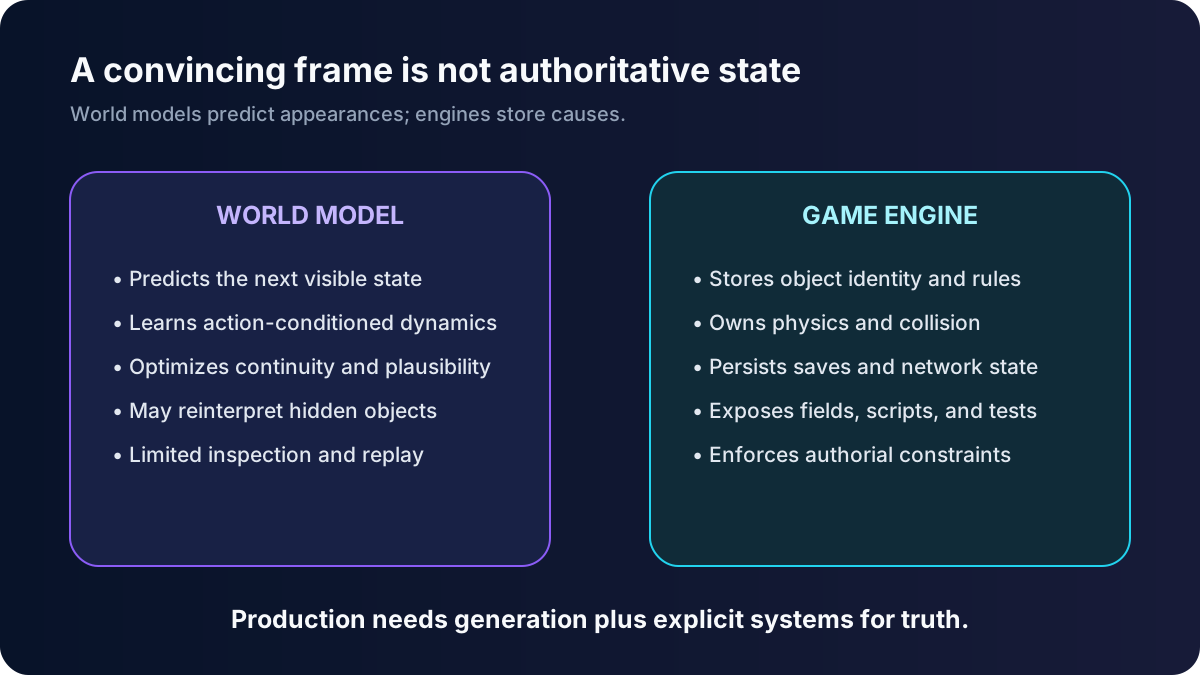
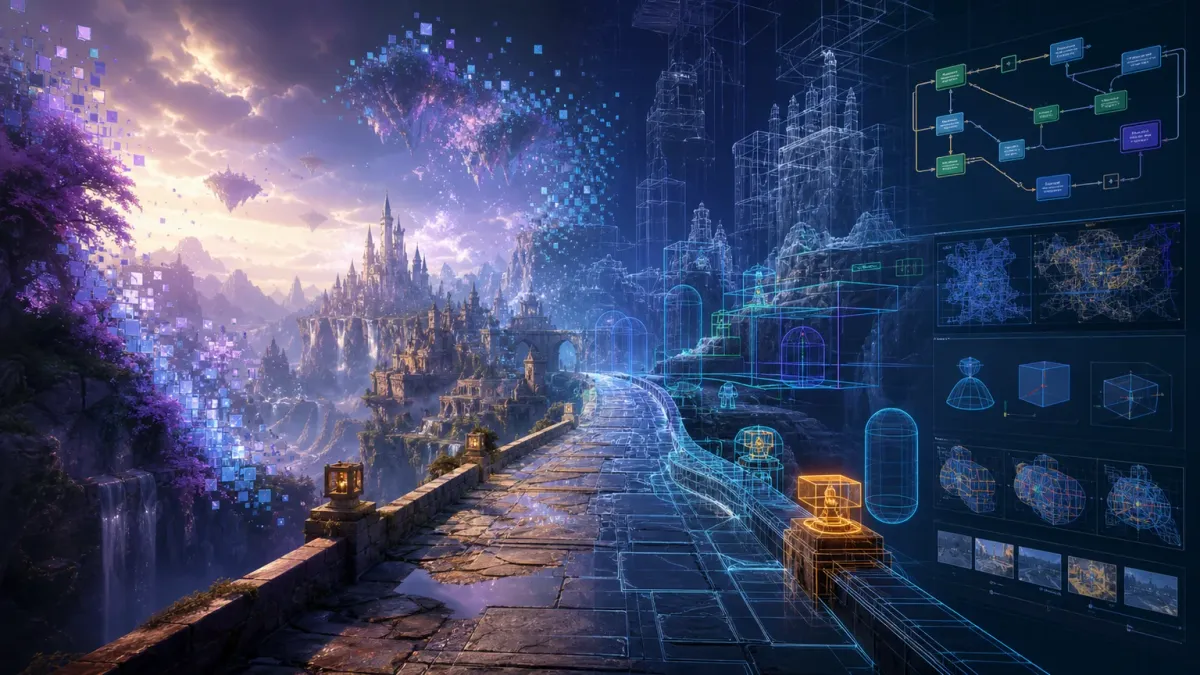
Figure: Visual continuity can support exploration, but production games also need inspectable identities, rules, persistence, and tests.
World models predict what happens next
Google defines a world model as a system that simulates an environment’s dynamics, including how the environment evolves and how actions affect it.
Project Genie is a web prototype powered by Genie 3, Gemini, and an image model. A user can describe a world with text or images, choose a perspective and movement style, then explore while Genie generates the path ahead in real time.
That is a meaningful change from video generation. A video is fixed after it is produced. A world model conditions the next output on the action a user takes.
Microsoft’s World and Human Action Model, introduced as Muse, approaches the same problem from recorded gameplay. Microsoft says the model was trained on more than one billion images and associated controller actions from Bleeding Edge, equivalent to over seven years of continuous human play.
The corresponding Nature paper describes a 1.6-billion-parameter model trained on approximately 500,000 player trajectories. It can predict world frames, plausible actions, or both. The research evaluates consistency, diversity, and whether user modifications persist as generation continues.
Both systems learn a relationship between visible worlds and action. Neither exposes the complete production representation expected from Unreal Engine, Unity, Godot, or a proprietary engine.
A game engine stores causes, not only appearances
When a conventional engine renders a locked door, the door is more than a collection of pixels.
It has an identifier, transform, collision shape, animation state, material, sound, ownership, network replication policy, interaction script, save-game representation, and relationship to a quest. A developer can inspect those fields, change one, reproduce a failure, and write a test around the result.
A generated scene may look like it contains the same door without exposing any of those causes. If the image changes after the player turns around, the model may preserve its appearance, forget it, or reinterpret it. Visual consistency is useful, but it is not equivalent to authoritative state.
Production games need at least six properties that a generated world must eventually provide:
- Identity: The same object remains addressable across frames, sessions, and systems.
- Rules: Physics and gameplay constraints can be declared rather than inferred repeatedly.
- Persistence: Player changes survive movement, loading, and save restoration.
- Debuggability: A developer can inspect why an outcome occurred and reproduce it.
- Performance budgets: CPU, GPU, memory, storage, and network costs remain predictable.
- Authorial control: A creative team can require an event, forbid another, and preserve intentional composition.
World models currently optimize the generated experience. Engines optimize the controllability of the system that produces it.
Muse is an ideation model by design
Microsoft presents Muse as a model for gameplay ideation, not a drop-in replacement for a shipping engine.
The Nature research began with interviews involving multidisciplinary creative teams. The researchers identified three needs for creative use: consistent generation, meaningful diversity, and persistent user modification.
Those criteria reveal the intended role. A designer may provide a short gameplay sequence, test several continuations, alter a state, and use the result to explore an idea before building it through conventional tools.
The value is similar to a sketchbook that understands motion and action. A static concept image can show a room. A gameplay model can suggest how the room might feel when a character moves, attacks, or encounters an opponent.
That can shorten preproduction without making the generated sequence the final game. Studios may use world models to explore mechanics, camera behavior, encounter pacing, animation, or old-game preservation before committing engineering and art resources.
The distinction protects the creative team from a false requirement. A prototype does not need perfect persistence or network determinism to answer whether an idea is promising. A shipped multiplayer game does.
Roblox is turning generated geometry into an API
Roblox’s work on Cube addresses a different layer of the problem: making generated objects compatible with gameplay code.
The company’s 4D generation beta does not merely produce the visual mesh of a car. A schema requires five named parts—a body and four wheels—so scripts can make the wheels spin and turn.
Roblox says early-access users generated more than 160,000 objects with 4D generation in Wish Master. The company also reports that players who engaged with the feature showed a 64% average increase in play time. That is a company-reported observation from one experience, not evidence that generated objects improve every game.
CubePart generalizes the schema idea. A creator can ask for a stylized tow truck while specifying named parts such as cab, chassis, wheels, roof beacon, and tow assembly. The model generates separate meshes that can connect to physics, animation, and scripts.
The schema is the important innovation. It acts as an API contract between generation and deterministic game code.
This is a plausible bridge between world models and engines:
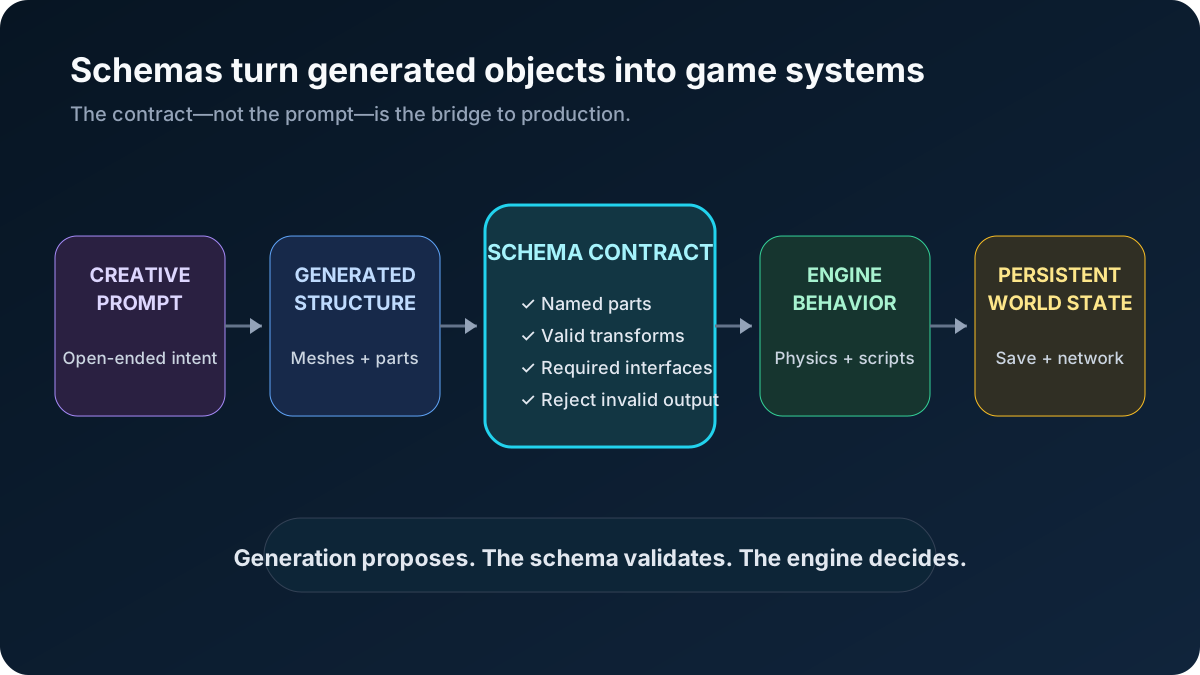
Figure: Generation becomes production-compatible when its output must satisfy interfaces that physics, scripts, saves, and networking can trust.
The model handles an open-ended creative request. The engine receives known parts with names and expectations it can enforce.
Control is becoming the central research problem
NVIDIA’s CTRL-G initiative, involving researchers from NVIDIA, Epic Games, and North Carolina State University, frames the challenge directly. The central problem for interactive generative systems is not output alone, but whether that output can be steered in real time, aligned with player intent, and integrated into production pipelines.
Control has several meanings in a game:
- A player expects the same input to produce a readable class of responses.
- A designer expects authored rules to override generated plausibility.
- An artist expects changes to preserve composition, style, and identity.
- A programmer expects generated entities to expose valid interfaces.
- A producer expects the feature to stay inside time and cost limits.
- A platform expects generated content to remain inside legal and safety policy.
A model can improve on one dimension while failing another. Higher visual fidelity may increase latency. More creative freedom may reduce reproducibility. Persistent simulation may increase memory and serving cost. Stronger moderation may remove the surprising behavior that made the feature attractive.
There is no single benchmark called “game quality” that resolves these trade-offs.
The first production uses will be bounded
World models are likely to enter game development in stages.
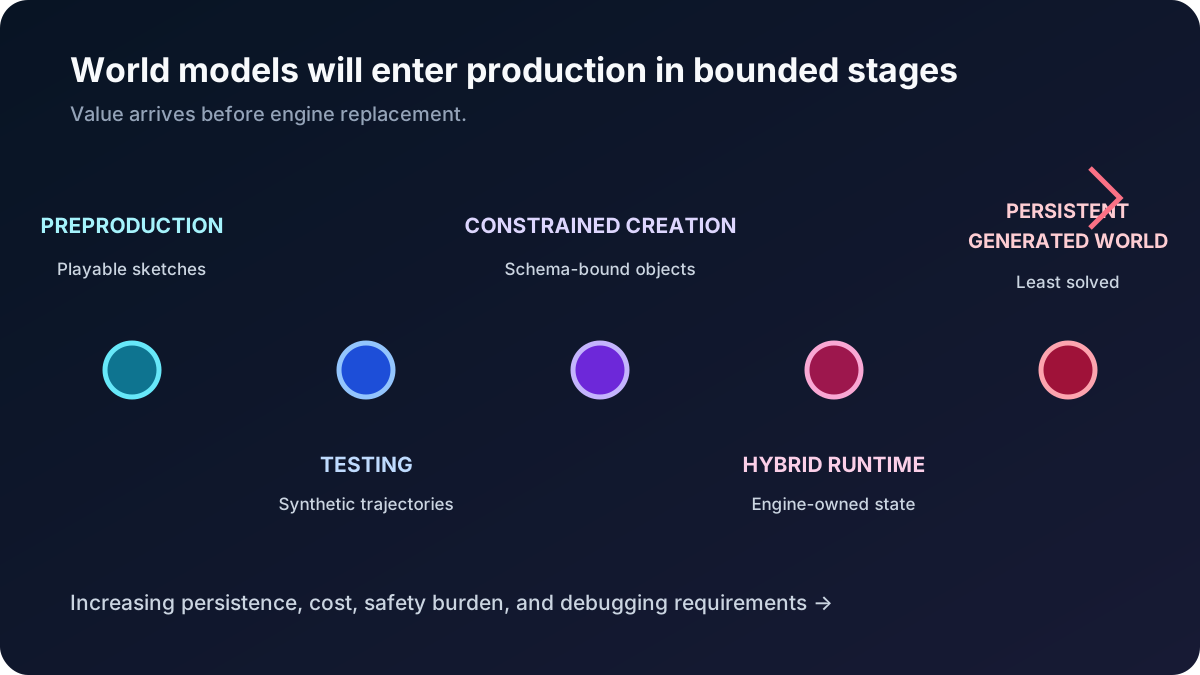
Figure: Near-term value lies in sketches, testing, constrained creation, and hybrid runtimes; fully generated persistent worlds carry the largest unresolved burden.
Preproduction
Designers can generate rough playable sketches, explore alternative mechanics, and communicate movement or camera ideas before a full prototype exists.
Testing and simulation
Models can propose edge cases, synthetic play trajectories, or environments for agent training. These uses can create value without becoming the player’s canonical world.
Constrained creation
Players may generate objects, rooms, or short experiences through schemas selected by the developer. The space of expression can be broad while the interfaces remain known.
Hybrid runtime experiences
A conventional engine can own state, physics, networking, and safety while a model produces presentation, variation, or low-stakes extensions. Our AI NPC architecture guide applies the same hybrid principle to language and character action.
Fully generated persistent worlds
This is the most ambitious stage and the least solved. It requires generated state that remains addressable, testable, affordable, and controllable across long sessions and many players.
The sequence matters. A technology does not need to replace an engine to become valuable inside one.
Evaluate the state, not the demo reel
When assessing a world-model demonstration, ask questions that the video may not answer:
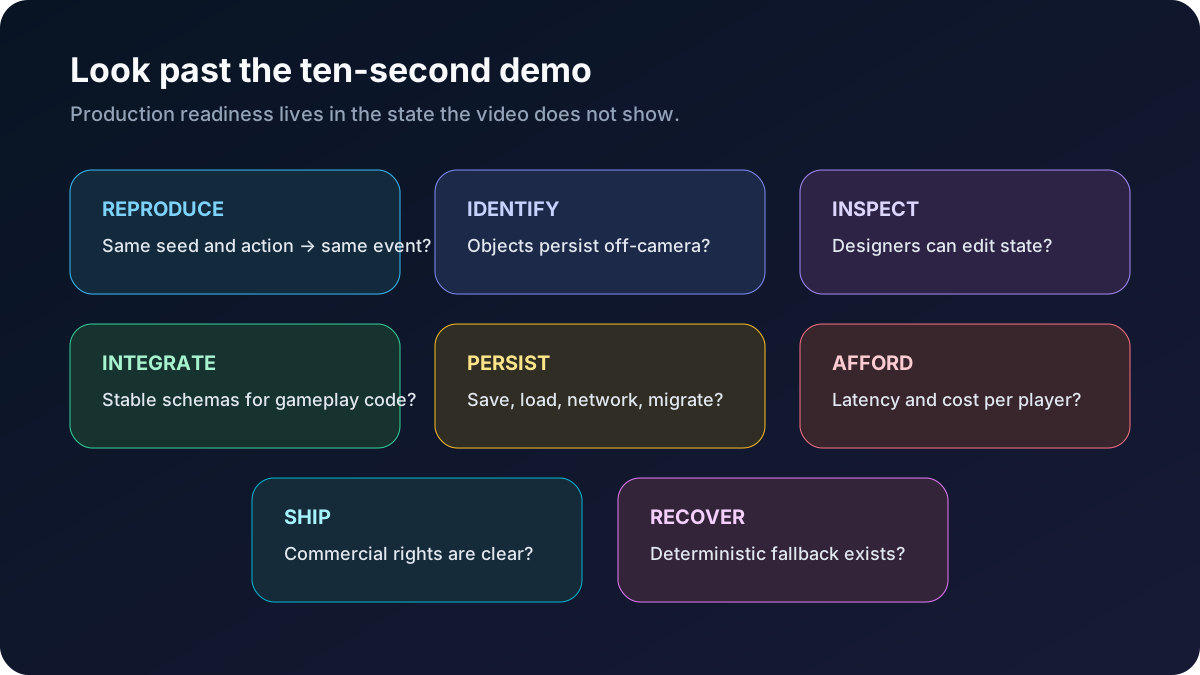
Figure: Reproduction, identity, inspection, integration, persistence, cost, rights, and recovery determine whether an interactive demo can become a product.
- Can the same seed and input reproduce the event?
- Does an object keep an identity after leaving the camera?
- Can a designer inspect and edit its state?
- Can gameplay code query it through a stable schema?
- What happens after ten minutes rather than ten seconds?
- Can the world be saved, loaded, networked, and migrated?
- What is the latency and inference cost per active player?
- Which training and generated assets can be shipped commercially?
- What deterministic fallback exists when generation fails?
These questions do not diminish Project Genie, Muse, Cube, or generative graphics research. They identify the engineering work required to turn a research capability into a reliable creative platform.
World models may eventually change what a game engine is. They could make simulation partly learned, rendering partly generated, and content creation continuous during play.
For now, the productive comparison is not model versus engine. It is model plus engine: learned generation for possibility, explicit systems for truth.
The same boundary appears in local-LLM civilization simulations, where model behavior becomes useful only after the surrounding system owns the loop, memory, and observability. It also explains why one-prompt game agents can accelerate prototypes without eliminating the need for an inspectable engine project.