The AI infrastructure race is usually described as a shortage of GPUs. Microsoft’s latest partnership with 3M is a reminder that an accelerator is useful only when the surrounding data center can power it, cool it, feed it data, and connect it to thousands of other processors.
On July 15, Microsoft and 3M announced that Azure will become the first publicly named hyperscale cloud provider to deploy 3M’s Expanded Beam Optical technology. The companies say the connection system is intended to improve the scalability, reliability, and efficiency of AI data-center infrastructure.
This is not as visible as a new model release, but it points toward the physical constraint underneath the AI boom. GPU supply and electricity are currently the most obvious bottlenecks. As clusters grow, optical links, packaging, cooling, and network maintenance become part of the same capacity problem.
What expanded-beam optics changes
Traditional fiber connectors align small physical fiber cores so light can pass across the connection. Contamination, alignment, and repeated handling can degrade that interface. Expanded-beam optics broadens and collimates the light before it crosses the connector, then focuses it back into the receiving fiber.
3M says its EBO ferrule uses a non-contact optical interface, supports multiple mating cycles, and can be integrated into high-density data-center connections. The company’s product sheet describes a genderless ferrule geometry intended to simplify deployment across the network.
The Microsoft announcement does not disclose deployment volume, cluster design, measured failure reduction, bandwidth, or financial terms. It therefore establishes a strategic direction, not enough data to calculate a performance or cost advantage.
The direction still matters. AI clusters require dense, high-bandwidth links between accelerators, racks, and facilities. A connector that is easier to manufacture, clean, service, and deploy at scale can affect uptime and build speed even though it does not change the model’s benchmark score.
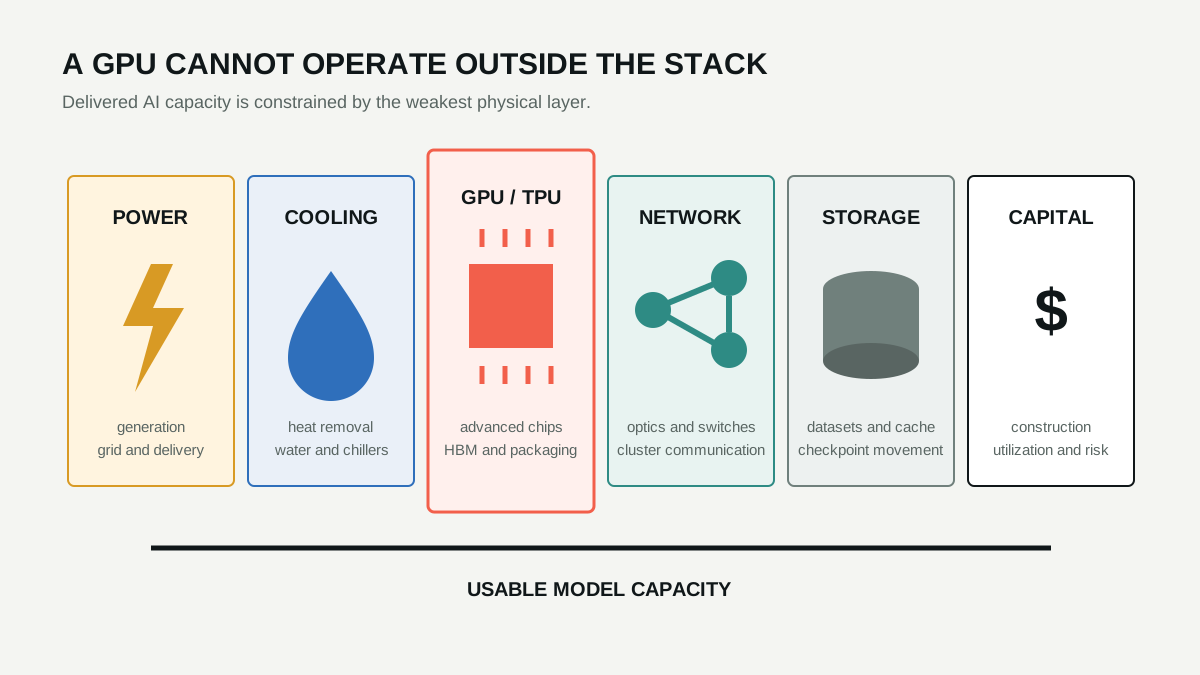
Figure: Accelerator availability is only one constraint. Power delivery, cooling, networking, optical packaging, storage, and capital determine how much compute reaches a model.
GPU and power remain the immediate constraints
The current bottleneck is best understood as a pair: advanced accelerators and the power required to operate them.
An AI company can purchase or reserve chips and still wait for energized data-center capacity. Utilities must provide generation and transmission. Developers must secure land, transformers, switchgear, cooling, permits, and network connectivity. A delay in any one layer can strand the rest of the investment.
This is why companies continue to spend heavily before AI infrastructure produces a stable standalone return. Compute capacity is both a product input and a strategic option. A provider that cannot serve training or inference demand when a new model arrives may lose customers even if waiting would improve near-term margins.
If utilization and revenue eventually catch up with that installed capacity, development can accelerate. More available compute allows larger experiments, broader post-training, longer evaluations, and lower queue times. But profitability does not automatically create physical supply; chip fabrication, grid construction, and data-center delivery still operate on multi-year schedules.
Better infrastructure does not guarantee cheaper APIs
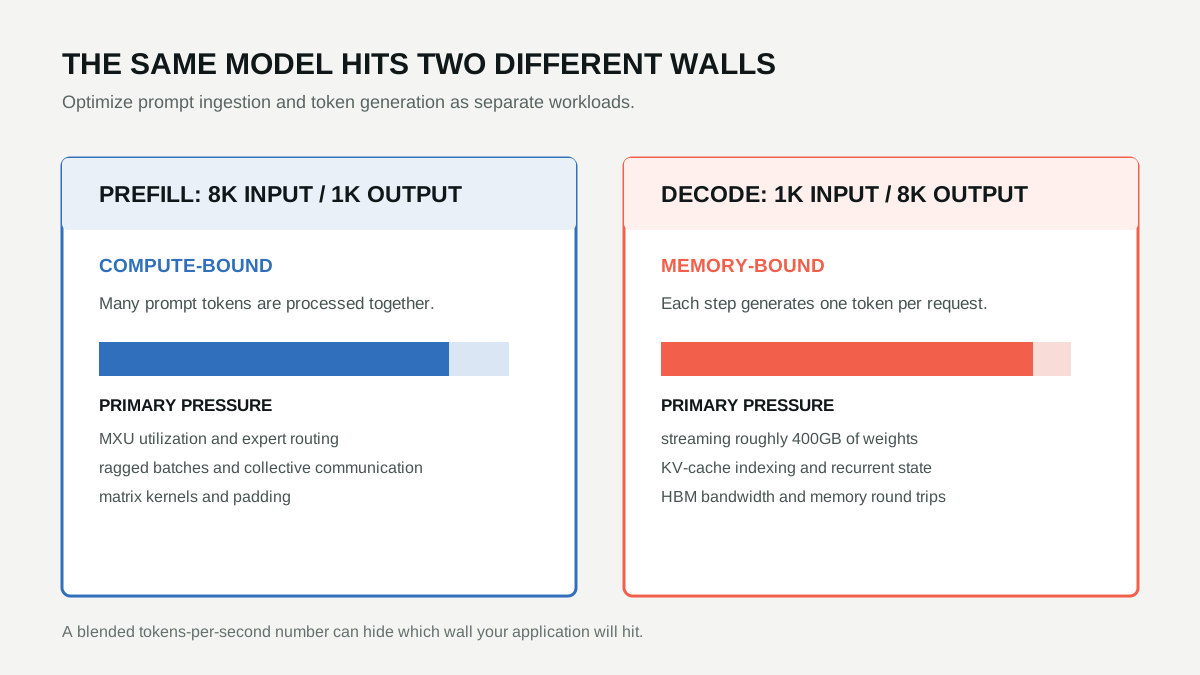
Figure: Long prompts stress matrix compute and routing while token generation repeatedly streams model weights and becomes memory-bound. Yield Signal Daily editorial diagram.
It is tempting to assume that every efficiency gain becomes a lower token price. That outcome is possible, but it is not automatic.
When hardware, networking, and serving software improve, a provider can use the gain in several ways:
- reduce the API price to win market share;
- preserve price and improve margin;
- spend the saved capacity on longer reasoning or larger context;
- reserve the strongest capability for a premium tier;
- serve more demand without building another facility immediately.
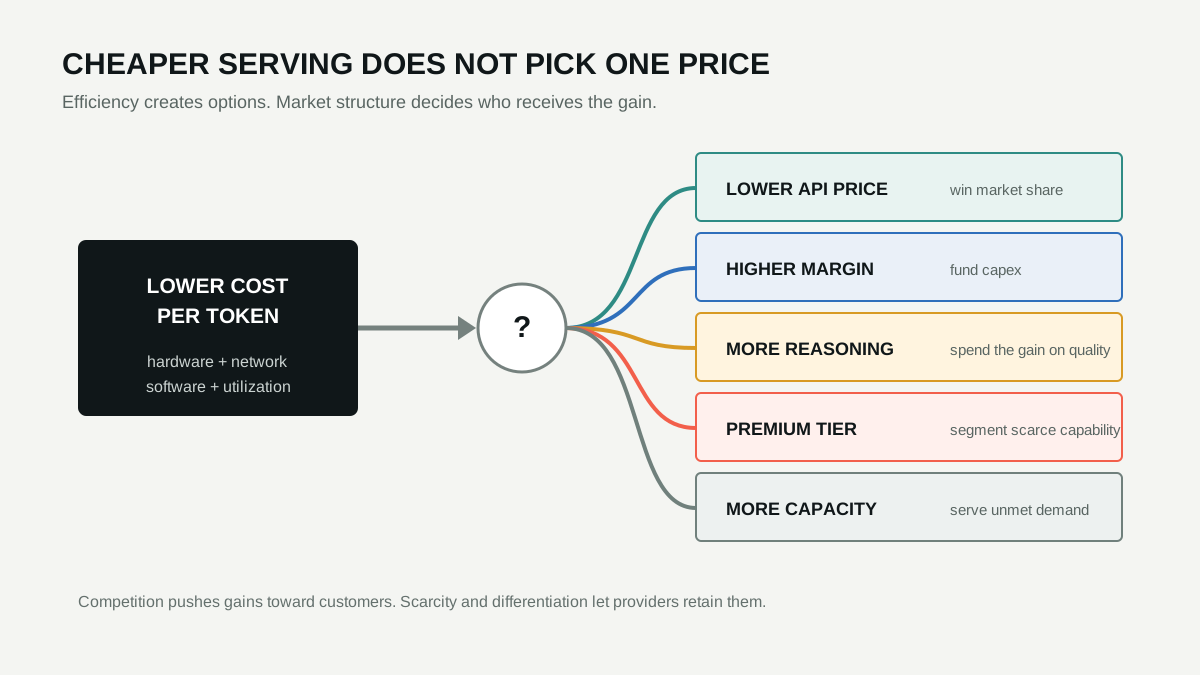
Figure: Lower infrastructure cost expands the provider’s options, but competition, scarcity, product segmentation, and data value determine what customers pay.
Prices could become more polarized. Commodity inference may continue to fall as open models and efficient hardware compete. The most capable agents may become more expensive if they consume longer reasoning traces, operate tools for hours, receive priority compute, or offer scarce reliability.
The value of user data can also change. Once a provider has sufficient broad training data, marginal interaction logs may be less valuable than high-quality expert demonstrations, verified task outcomes, or proprietary enterprise workflows. That would weaken one historical subsidy for low consumer prices. Providers could charge more for premium intelligence while keeping a low-cost tier for distribution.
This remains a market hypothesis, not a confirmed pricing trajectory. Strong competition can force efficiency gains back to users, especially when customers can route work between APIs and self-hosted models.
The market can be overbuilt and undersupplied at the same time
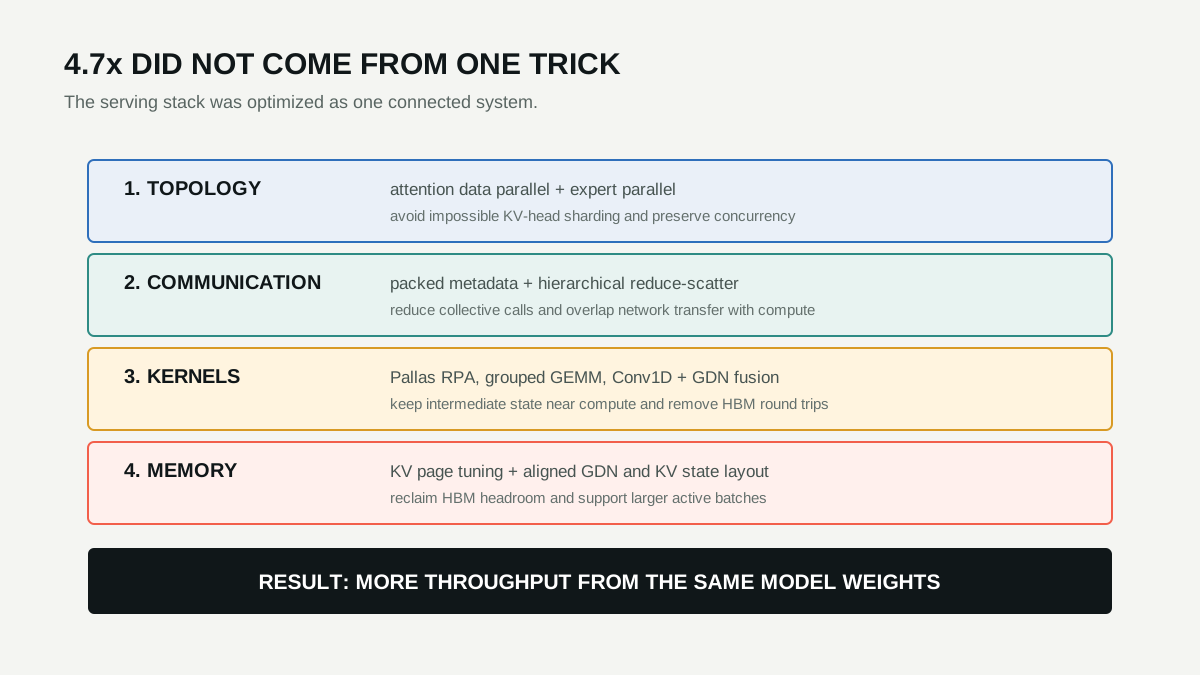
Figure: Large inference gains require coordinated topology, communication, kernel, quantization, and memory-layout changes. Yield Signal Daily editorial diagram.
AI infrastructure shows signs of speculative excess: enormous capital commitments, aggressive demand forecasts, and projects financed before long-term utilization is proven. That does not mean current supply is sufficient.
The two conditions can coexist because capacity is not interchangeable. A future facility in the wrong region does not solve today’s shortage near a customer. A data center without power, networking, or the correct accelerators is not usable AI capacity. A cluster optimized for training may not meet the latency and availability requirements of inference.
The orbital-data-center proposals associated with Elon Musk dramatize the constraint. SpaceX has discussed solar-powered AI compute in orbit, and reporting says it has proposed very large satellite constellations. The plan faces difficult economics, radiation, maintenance, launch, thermal, and networking problems. It should not be treated as evidence that terrestrial capacity is impossible.
It does show how seriously the industry takes the power and siting problem. Moving compute into space is an extreme response to the belief that electricity and terrestrial construction will limit AI growth. Reuters reported that Google has also researched orbital AI infrastructure through Project Suncatcher, while experts continue to debate whether the economics can work.
What developers should watch
The Microsoft-3M announcement becomes meaningful when deployment metrics appear. Developers and investors should watch for:
- connector density and supported bandwidth;
- insertion-loss performance across repeated mating cycles;
- cleaning and maintenance time compared with conventional connectors;
- failure rates at cluster scale;
- deployment time and total installed cost;
- whether the technology reaches production AI clusters or remains limited to trials.
At the software layer, watch utilization and delivered token economics rather than total capital expenditure alone. A huge cluster can still be inefficient if communication stalls, batches remain underfilled, or models spend compute on reasoning that users do not value.
The bottleneck is becoming a stack
The next phase of AI competition will not be decided by GPU count alone. Accelerators sit inside a physical and financial system, and the weakest layer constrains the cluster.
Microsoft’s decision to work with 3M on optical connectivity suggests hyperscalers are optimizing deeper into that stack. Power and chips remain the immediate pressure points, but network reliability and serviceability become more important as facilities contain more accelerators and more optical connections.
Infrastructure efficiency will expand AI capacity. Whether it lowers the developer’s bill is a separate question. The answer will depend not only on engineering progress but on competition, scarcity, product segmentation, and who captures the margin created by that progress.