When every team receives the same model, hardware, and inference rules, the leaderboard stops being a model popularity contest. It becomes a test of data and workflow engineering.
That is what makes NVIDIA’s latest analysis of the Nemotron Model Reasoning Challenge unusually useful. More than 5,000 active participants across 4,000 teams worked with the same Nemotron-3-Nano-30B base model. They could not use the internet during evaluation, modify inference code, or submit an entirely new model. Their submissions were limited to LoRA adapters with rank 32 or lower.
Under those constraints, stronger results came from verified synthetic reasoning traces, targeted solvers, compact representations, and evaluation against real failure modes. The competition supports a practical conclusion many AI teams discover during hackathons and product development: model quality matters, but the data and workflow surrounding the model can determine whether that capability becomes a reliable product.
The constraint makes the result valuable
Most benchmark comparisons change several variables at once. One model may have more parameters, a different training set, a larger context window, a proprietary tool harness, and more inference-time compute. A higher score does not reveal which difference produced the gain.
The NVIDIA challenge narrowed the experiment:
| Variable | Competition constraint |
|---|---|
| Base model | Nemotron-3-Nano-30B |
| Submitted artifact | LoRA adapter, rank 32 or lower |
| Inference code | fixed |
| Evaluation internet | unavailable |
| Hardware | Google Cloud G4 VM with RTX PRO 6000 Blackwell |
| Final result | private leaderboard |
The task required the model to infer hidden transformations in abstract reasoning puzzles, show a reasoning trace, and return the answer within a token budget. Because the major model and infrastructure variables were fixed, teams had to compete on how they generated training data, represented the problem, checked intermediate steps, and allocated limited context.
This is closer to many real production decisions than another frontier-model launch. A team often cannot train a new foundation model. It can improve the examples, retrieval, prompts, tools, verification, routing, and evaluation around the model it already pays for.
A plausible trace is not automatically useful data
Many top teams used synthetic chain-of-thought data. The important step was verification.
NVIDIA contrasts a weak pipeline, prompt -> final answer, with a stronger one: prompt -> solver-generated trace -> check or repair -> train. First-place and second-place writeups both described workflows that generated problems and traces separately, then trained on the resulting checked examples.
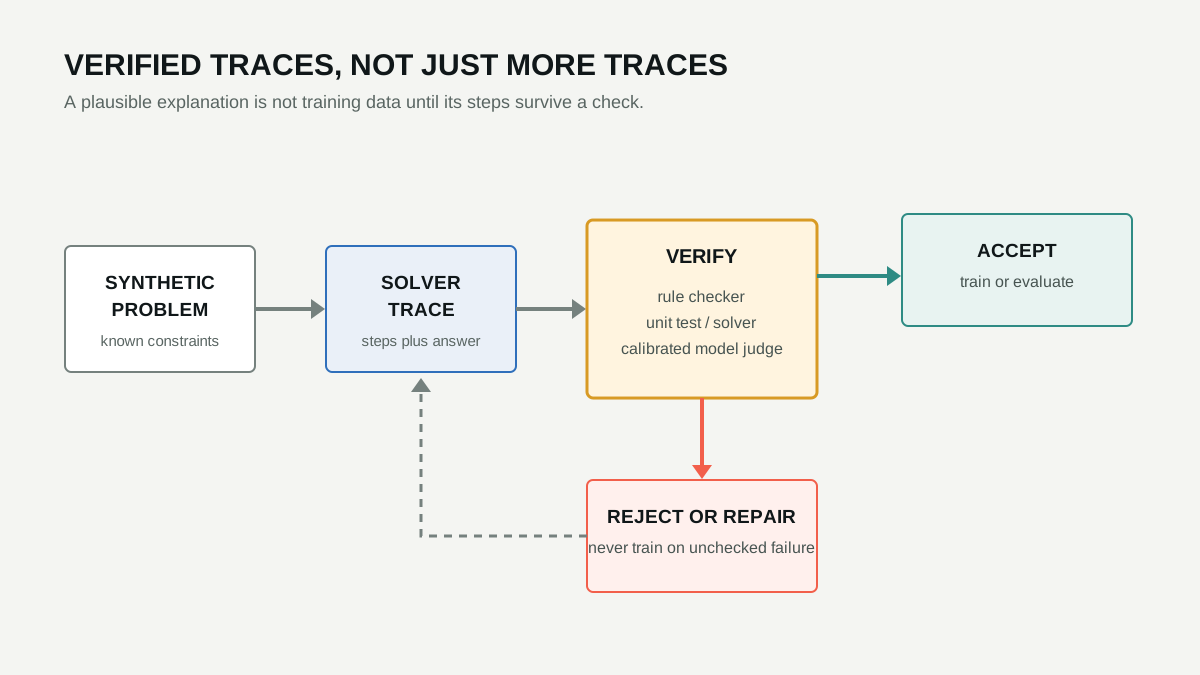
Figure: Synthetic reasoning becomes useful training data only after an independent check can reject or repair invalid intermediate steps.
This matters because a reasoning trace can sound coherent while teaching a shortcut that fails outside the synthetic distribution. More tokens do not guarantee more truth. A useful trace should satisfy at least four tests:
- each transformation can be reproduced;
- the trace uses only evidence available at that step;
- the final answer follows from the recorded operations;
- a failed trace is rejected or repaired rather than added to training.
For tasks with formal rules, code is the strongest verifier. Unit tests, parsers, symbolic solvers, database constraints, and simulation environments can provide a deterministic signal. For open-ended work, an LLM judge can still be valuable, especially when calibrated against human examples and asked to evaluate narrow criteria rather than an entire response at once.
The right conclusion is not that models cannot evaluate models. Current systems can already perform useful critique, comparison, and error clustering. The evaluation becomes stronger when a more precise rubric, multiple passes, counterexamples, and deterministic checks surround that judgment.
Why the workflow can beat the default model experience
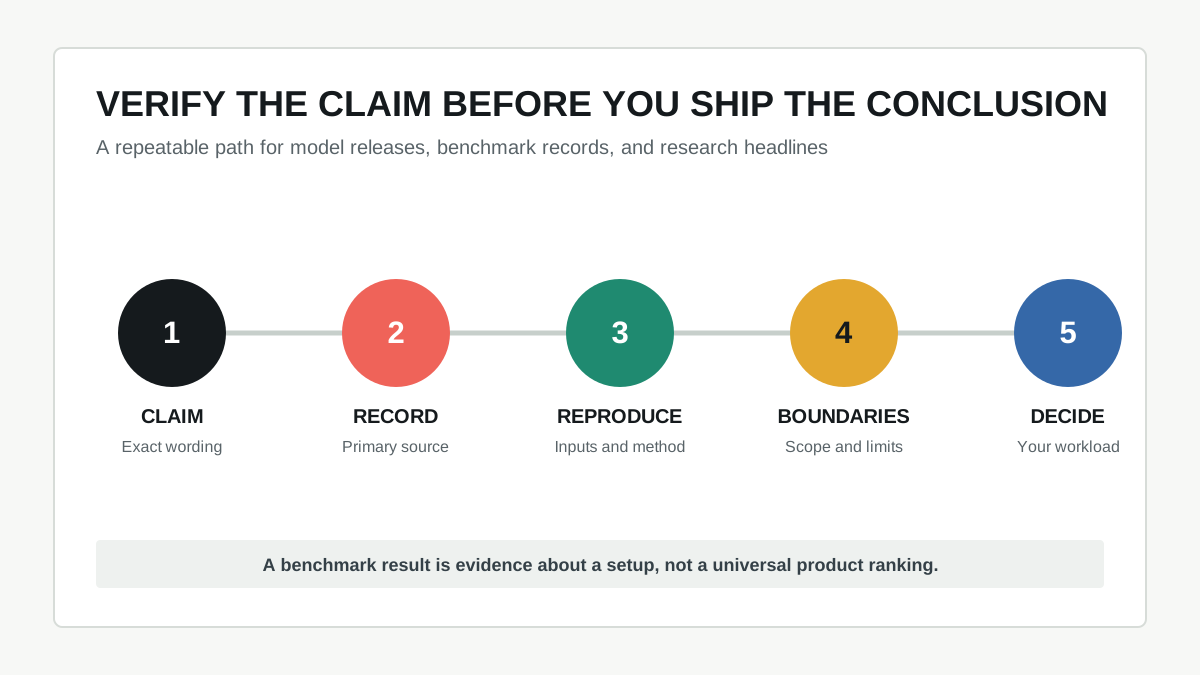
Figure: A consequential model claim should move from source recovery through reproduction and independent review before publication. Yield Signal Daily editorial diagram.
Creative AI products provide a visible version of the same effect. Higgsfield can expose Google’s Veo models, yet a generation made through Higgsfield can differ substantially from a basic model interface because the product adds an opinionated workflow around the generator.
Higgsfield describes its current stack as a suite combining multiple generation models with persistent character identity, camera control, lip synchronization, marketing workflows, and end-to-end production tools. Its earlier Veo 3 integration connected image creation, character identity, scene direction, speech, and video generation in one pipeline.
That does not prove Higgsfield’s output is universally better than Google’s own tools. It demonstrates why two products using a related underlying model can produce different user outcomes. One may improve the input, preserve identity, constrain camera motion, route between models, add references, and perform post-processing. The foundation model sets the capability ceiling; the workflow determines how often users reach it.
The same pattern appears in coding agents. A raw model call and a production coding agent may share a model, but repository indexing, tool schemas, test execution, context selection, patch review, and retry policy create very different reliability.
Intermediate evaluation tells engineers where to invest
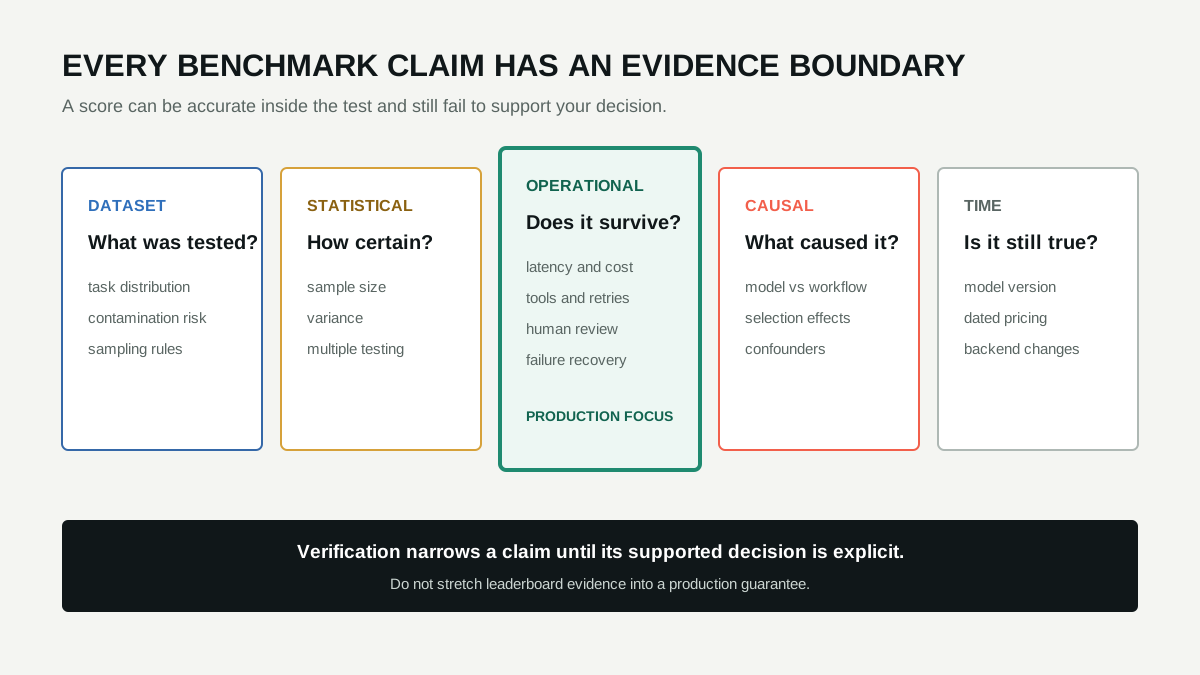
Figure: Dataset, statistical, operational, causal, and time boundaries must be explicit before a result supports a production decision. Yield Signal Daily editorial diagram.
Final-answer accuracy is necessary, but it is a poor debugging interface.
Suppose an agent fails a data-analysis task. The final answer alone cannot tell the team whether it retrieved the wrong table, generated invalid SQL, misunderstood a date boundary, lost evidence during context compression, or calculated the metric incorrectly. Replacing the model may improve the aggregate score while leaving the hidden failure untouched.
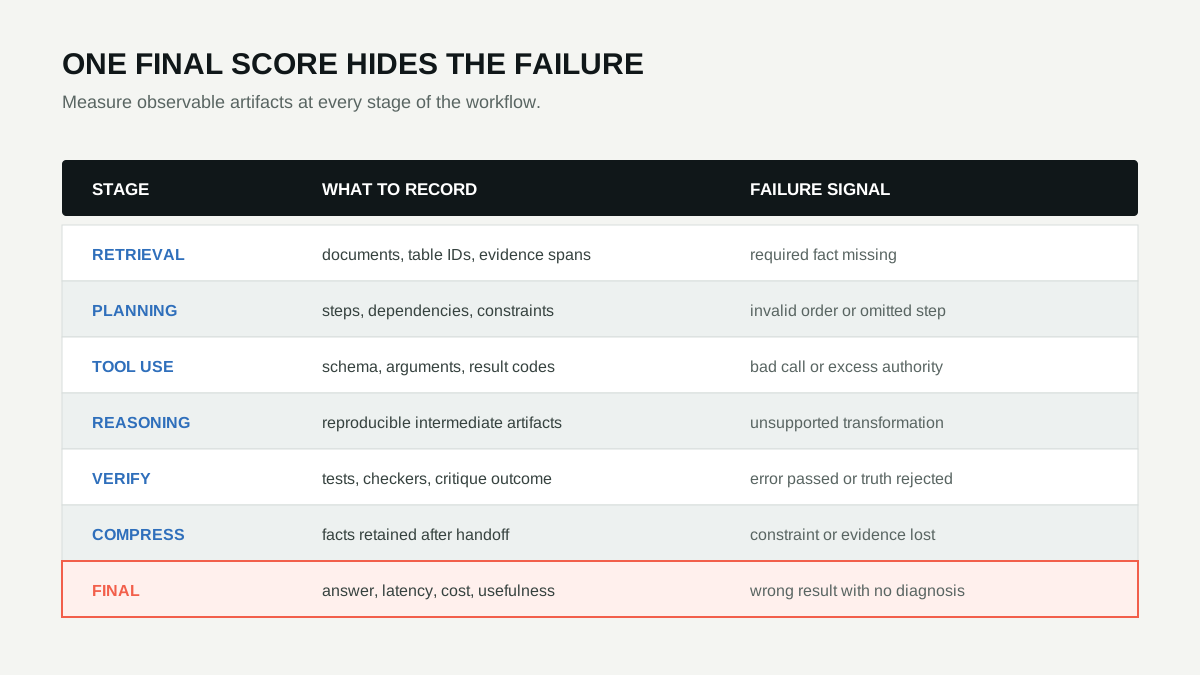
Figure: Stage-level evaluation turns one final score into actionable signals for retrieval, planning, execution, verification, and compression.
A production evaluation suite should therefore track the workflow by stage:
| Stage | Example measurement |
|---|---|
| Retrieval | required evidence found, distractor rejection |
| Planning | valid decomposition, dependency order |
| Tool use | schema validity, argument accuracy, unnecessary calls |
| Reasoning | reproducible steps, unsupported claims |
| Verification | error detection rate, false rejection rate |
| Compression | critical facts retained after summarization |
| Final answer | correctness, usefulness, latency, and cost |
This is why inspecting the intermediate work matters. It is not about publishing hidden chain-of-thought or treating every generated explanation as a faithful description of internal computation. It is about recording observable artifacts: plans, retrieved documents, code, tool calls, test results, state transitions, and concise rationales that engineers can actually verify.
Compression is part of reasoning performance
The challenge also rewarded teams that fit useful reasoning into the available token budget. NVIDIA reports that participants compressed traces, separated reusable knowledge from problem-specific work, and designed representations around the benchmark’s hidden transformation families.
This has a direct production parallel. Long traces increase latency and cost, and they can crowd evidence out of the context window. A stronger workflow preserves the decisive facts and drops redundant narration.
Teams should evaluate compression as a transformation with its own failure rate. Give the system a known set of constraints, compress the session, and test whether it can still recover commitments, unresolved errors, tool outputs, and security boundaries. A shorter context is only an optimization when it preserves the state required for the next action.
Reasoning performance includes the workflow
The Nemotron challenge does not show that the model is unimportant. A weak base model can limit every downstream technique, and a stronger model can reduce the amount of scaffolding required.
It shows that after a model crosses a useful capability threshold, engineering leverage moves outward. Verified data can matter more than unfiltered scale. Stage-level evaluation can matter more than a single benchmark average. Compact reasoning and targeted tools can matter more than asking the model to think indefinitely.
For a small AI team, this is good news. Training a frontier model may be impossible, but building a better data flywheel and evaluation harness is attainable. The durable advantage may not be exclusive access to a model. It may be knowing exactly where that model fails and operating a workflow that catches the failure before the user does.