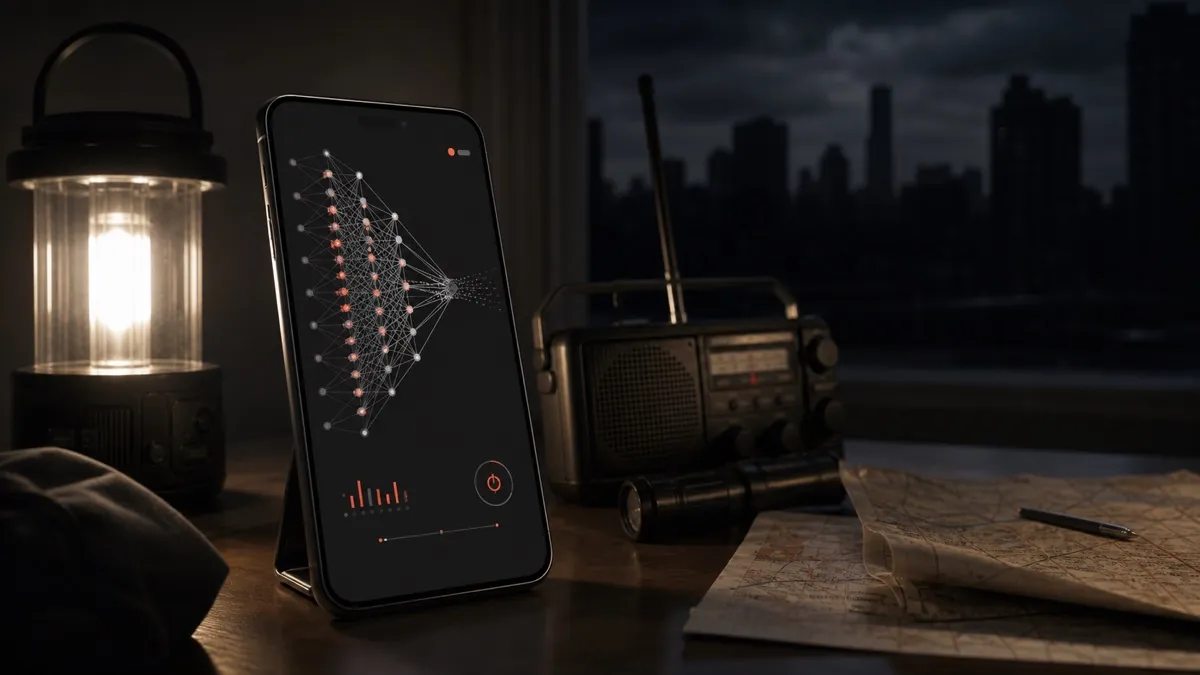
When a blackout or remote journey removes the network, the most useful AI model is not the smartest one on a benchmark. It is the one still available on the phone in your hand.
That is the right lens for PrismML’s Bonsai 27B release, a compressed version of Qwen3.6 27B that the company says can run locally on an iPhone 17 Pro. The 1-bit variant occupies 3.9GB, while a less aggressive ternary version occupies 5.9GB for laptop-class deployments.
The goal is not to make a phone impersonate a frontier data center. It is to preserve a bounded level of private assistance when the cloud is slow, unavailable, too expensive, or inappropriate for the data involved. Performance will be lower, and the phone remains constrained by heat, battery, memory bandwidth, and application memory limits. In a failure scenario, availability can still matter more than peak benchmark quality.
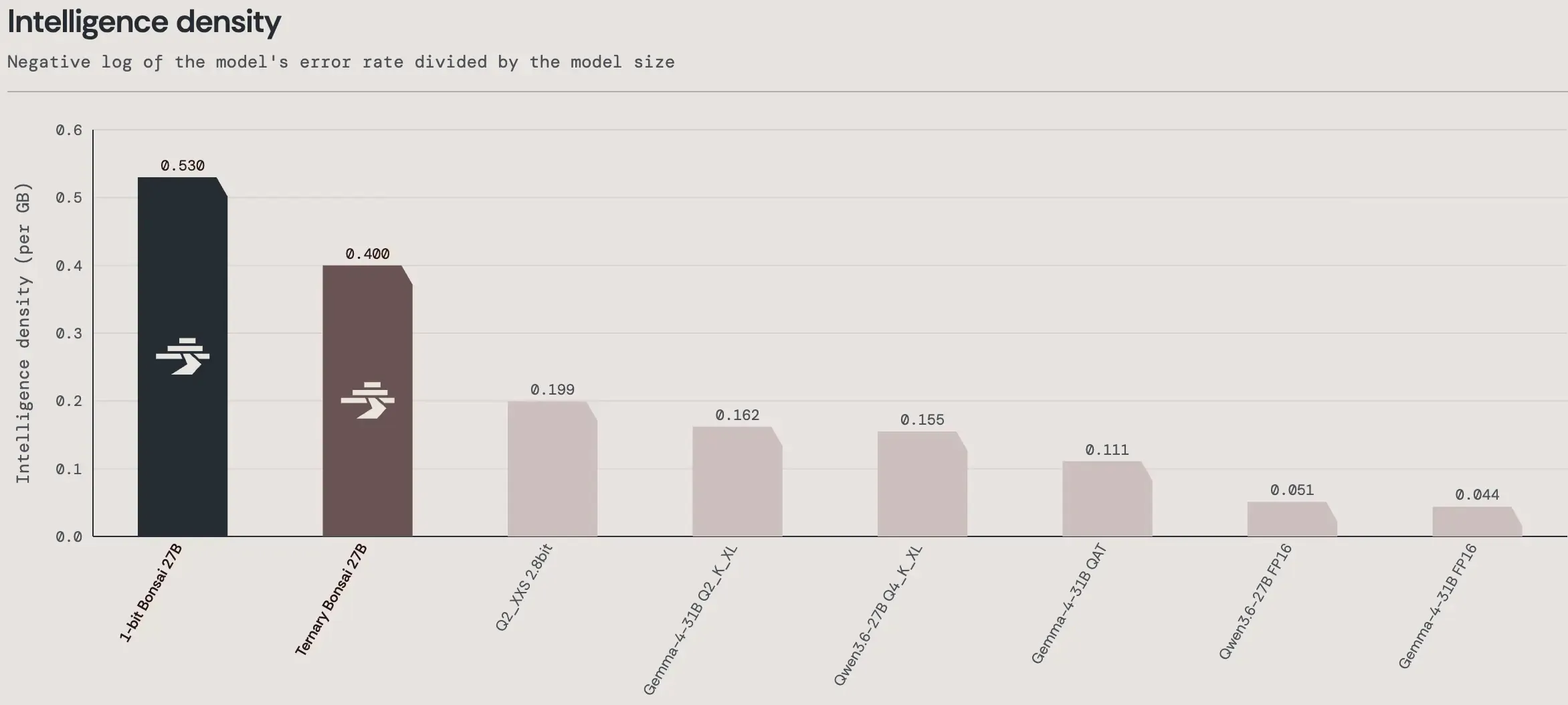
Figure: PrismML’s intelligence-density comparison. It is a vendor-produced metric and should not be treated as independent validation. Source: PrismML.
What PrismML actually shipped
Bonsai 27B is based on the open Qwen3.6 27B multimodal model. PrismML applies low-bit representation across embeddings, attention, MLP layers, and the language-model head instead of retaining broad high-precision escape paths. The vision tower remains in a compact 4-bit format.
The company reports the following operating points:
| Variant | Effective weight precision | Footprint | Intended device |
|---|---|---|---|
| 1-bit Bonsai 27B | 1.125 bits | 3.9GB | high-end phone |
| Ternary Bonsai 27B | 1.71 bits | 5.9GB | laptop or desktop |
| Full-precision reference | 16 bits | about 54GB | workstation or server |
PrismML reports 11 tokens per second for the 1-bit model on an iPhone 17 Pro and support for a 262K-token context window. Those numbers require context. A model’s weight file is not its full runtime footprint: KV cache, activations, the application, and the operating system all compete for memory. A long advertised context window therefore does not mean a phone can use the entire window comfortably in every workload.
The phone demonstration is also labeled as using cached and prefilled image context. That is a useful engineering optimization, but it means the demo should not be read as a universal end-to-end latency measurement.
The average score hides the important losses
Across PrismML’s 15-benchmark suite, the 1-bit model scored 76.1 against 85.0 for the full-precision reference, or roughly 90% retention by the company’s aggregation. The category breakdown is more informative:
| Capability | Full Qwen3.6 27B | 1-bit Bonsai 27B |
|---|---|---|
| Math | 95.3 | 91.7 |
| Coding | 88.7 | 81.9 |
| Agent and tool calling | 80.0 | 66.0 |
| Instruction following | 78.4 | 65.8 |
| Vision | 72.6 | 59.6 |
Compression preserved much of the math and coding score, but the drop in tool use and instruction following is exactly where an automated assistant can become unreliable. Developers should not infer that a phone can safely run hundreds of autonomous steps merely because the average retention number is high.
These are vendor results. Independent reproduction on sustained mobile workloads, including battery draw, thermal throttling, time to first token, tool-schema errors, and long-session drift, is still needed.
Why emergency availability is a real product advantage
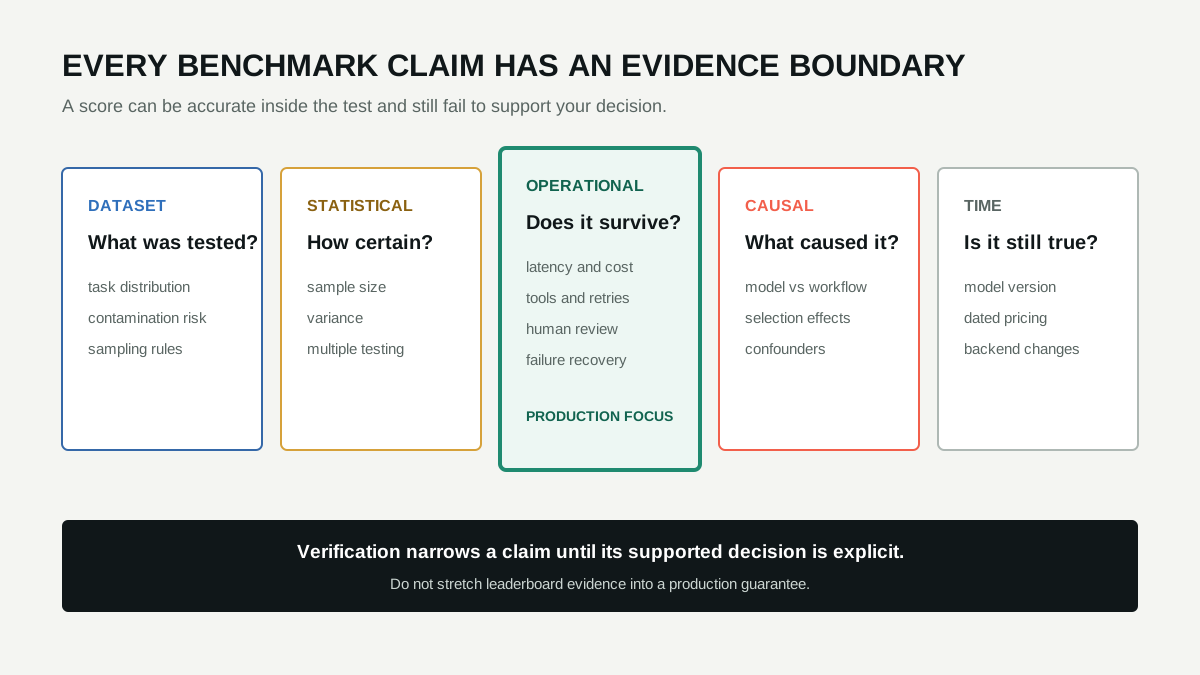
Figure: Dataset, statistical, operational, causal, and time boundaries must be explicit before a result supports a production decision. Yield Signal Daily editorial diagram.
A local model cannot restore cellular service, replace emergency responders, or manufacture facts that were never downloaded. It can still make already available information easier to use when normal interfaces fail.
An offline assistant could search a cached first-aid manual, translate stored instructions, summarize a local emergency plan, locate a contact in an encrypted address book, explain a downloaded map, or turn a checklist into step-by-step actions. In a remote area, it could help organize the information already on the device without waiting for a network round trip.
That product must be conservative. Official guidance should be stored with provenance and a last-updated date. The assistant should quote or link the relevant source, disclose when it is operating offline, and avoid presenting generated medical or safety advice as authoritative. Ready.gov’s emergency-communications material is the kind of verified resource an offline pack could preserve; the language model is the interface, not the authority.
Battery is also part of the safety model. Continuous 27B inference may be the wrong choice during a long outage. A production system should support a low-power search mode, smaller fallback models, and explicit inference budgets.
Hybrid is the realistic default
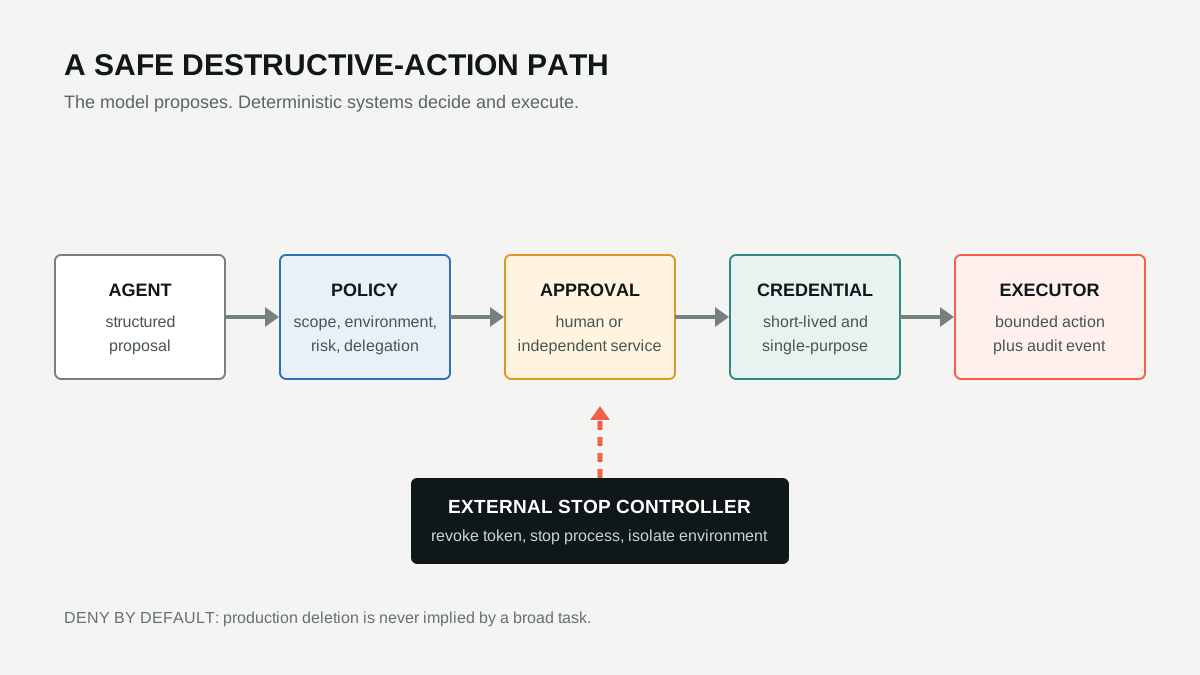
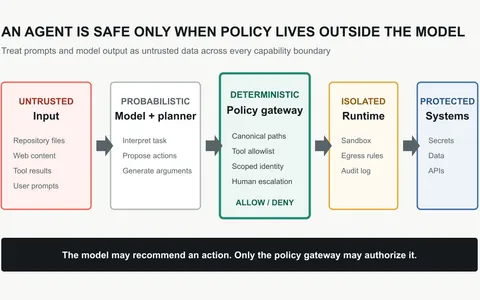
Figure: A production agent encounters deterministic policy gates before an irreversible operation and an external stop control during execution. Yield Signal Daily editorial diagram.
The practical architecture is not local versus cloud. It is a router that chooses between them.
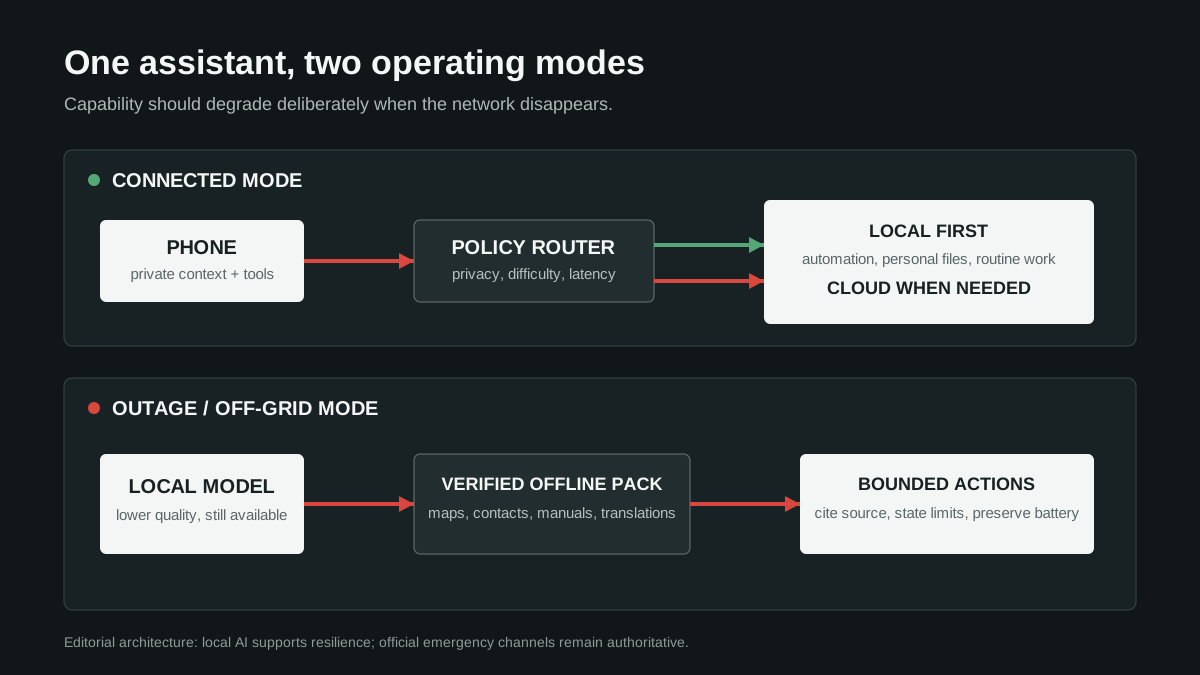
Figure: A connected assistant can keep private and routine work local while escalating difficult reasoning. During an outage, it should enter a deliberately limited mode backed by verified offline resources.
In normal operation, local inference should handle privacy-sensitive context, routine automation, retrieval over personal files, and fast device commands. A cloud model can receive a minimized request when a task requires stronger reasoning, broader current knowledge, or compute the phone cannot sustain.
When connectivity disappears, the same product should not silently behave as though nothing changed. It should enter an offline mode with a visible capability boundary, disable network-dependent tools, reduce context, preserve battery, and prefer deterministic utilities over free-form generation.
This also creates a sensible privacy boundary. Calendar details, messages, local documents, and behavioral preferences can remain on the device for personalization. The router can redact or summarize only what a remote model needs. Local execution does not automatically guarantee privacy, however; application telemetry, backups, tool permissions, and model update channels still require review.
Smartphone automation and a personal assistant come first
The most credible near-term product is a device-level assistant, not a general autonomous scientist in a pocket.
Useful tasks include sorting notifications, drafting replies from local context, scheduling across personal calendars, retrieving files, operating accessibility features, and executing approved multi-app routines. These workflows benefit from personalization and privacy, and many can tolerate a smaller model if tool permissions are narrow and the operating system validates every state-changing action.
The design should follow three rules:
- The model proposes an intent; the operating system authorizes the action.
- Sensitive memory is structured, encrypted, reviewable, and deletable.
- A failed model call returns control to a deterministic interface instead of trapping the user in an agent loop.
This is the same principle behind a production AI game agent: language is probabilistic, but authority must remain deterministic.
The cloud supplies capability; the phone supplies continuity
Bonsai 27B moves the mobile threshold in a meaningful direction. Fitting a 27B-class model into 3.9GB makes offline reasoning, private personalization, and resilient assistance more plausible than they were with conventional 4-bit builds.
It does not remove the phone’s physical constraints. The benchmark losses in tool use and instruction following make a cloud-quality autonomous assistant unlikely without routing, validation, and fallback systems. Mobile chips will need substantial gains in memory bandwidth, efficiency, and sustained thermal performance before local-only systems can match the strongest cloud experiences.
The winning architecture is therefore hybrid during ordinary life and intentionally local during failure. The cloud supplies peak capability. The phone supplies continuity, privacy, and a minimum useful level of intelligence when the network cannot.