Production prompts should be compiled, tested, and released like software. Editing one giant system-prompt string in production is the agent equivalent of deploying an application from an unvalidated template.
A Google Developers article published July 16 proposes modular prompt transpilation: teams author small instruction and skill files, resolve their dependencies at build time, validate the resulting artifact, and deploy only the rendered output. The pattern is not a new model feature. It is a useful LLMOps contract.
The deeper benefit is accountability. When an agent behaves differently after a prompt change, the team can identify the source module, rendered artifact, evaluation run, reviewer, and production version.
Monolithic prompts hide their blast radius
Early agents often have one readable instruction file. Production adds safety policy, tool rules, domain behavior, output schemas, regional requirements, and escalation paths. The file grows until no reviewer can predict which workflow a sentence may alter.
Google identifies three common failures: the blast radius of a change becomes obscure, shared instructions drift through copy and paste, and missing variables or imports fail only when a rare runtime branch executes.
Those are software configuration problems. A longer prompt-writing guide does not solve them. The instruction layer needs module boundaries and a build graph.

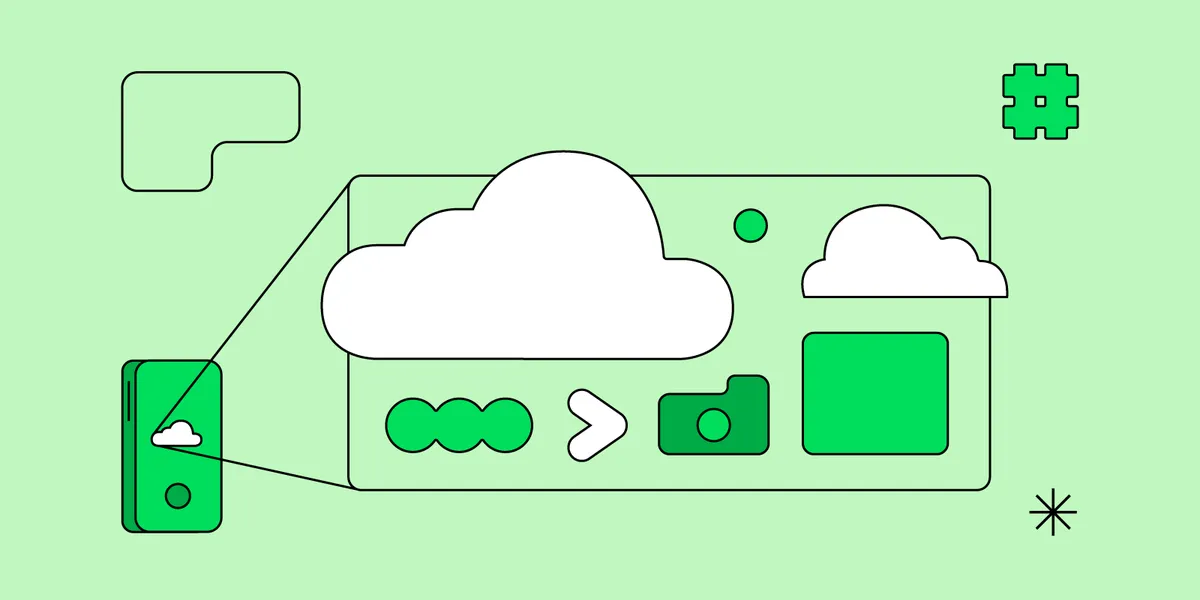
Google’s proposed pipeline renders modular source files and variables into one deterministic production prompt. Source: Google Developers Blog.
A practical source tree might separate stable identity, safety constraints, environment-specific tool policy, domain skills, and output format. A top-level template imports only the modules required by that agent. Production never reads the source tree dynamically; it receives a compiled artifact with a content hash.
The build should fail before the model sees anything
A prompt transpiler should reject undefined variables, missing imports, circular dependencies, invalid module versions, and forbidden combinations. It should also generate a dependency graph that reviewers can inspect.
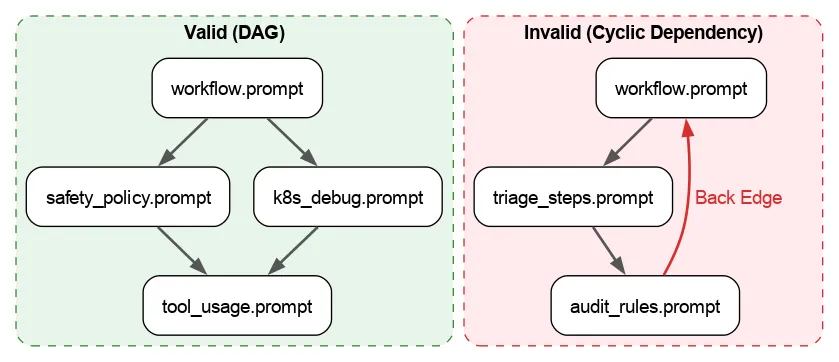
Static analysis can catch missing modules and dependency cycles before an agent run begins. Source: Google Developers Blog.
The rendered prompt can then pass a release pipeline:
- Parse and resolve every module.
- Validate required variables and policy declarations.
- Render a deterministic artifact.
- Compare it with the committed golden file.
- Run targeted behavioral evals based on changed modules.
- Record approval and publish the content hash.
The golden-file comparison closes a subtle gap. If the committed artifact differs from a clean rebuild, the repository is not an accurate description of production. The build should fail instead of letting that drift become a debugging problem.
Behavioral tests still matter because a syntactically valid prompt can produce a bad agent. Static checks answer whether the prompt can be built. Evals answer whether the resulting behavior remains acceptable.
Progressive disclosure protects the context window
Modularity does not mean concatenating every available skill into every request. That would reproduce the monolith at runtime and spend tokens on irrelevant instructions.
Google recommends progressive disclosure: keep non-negotiable identity and safety policy in the compiled base prompt, then let the agent retrieve task-specific skill modules through a bounded tool when needed.
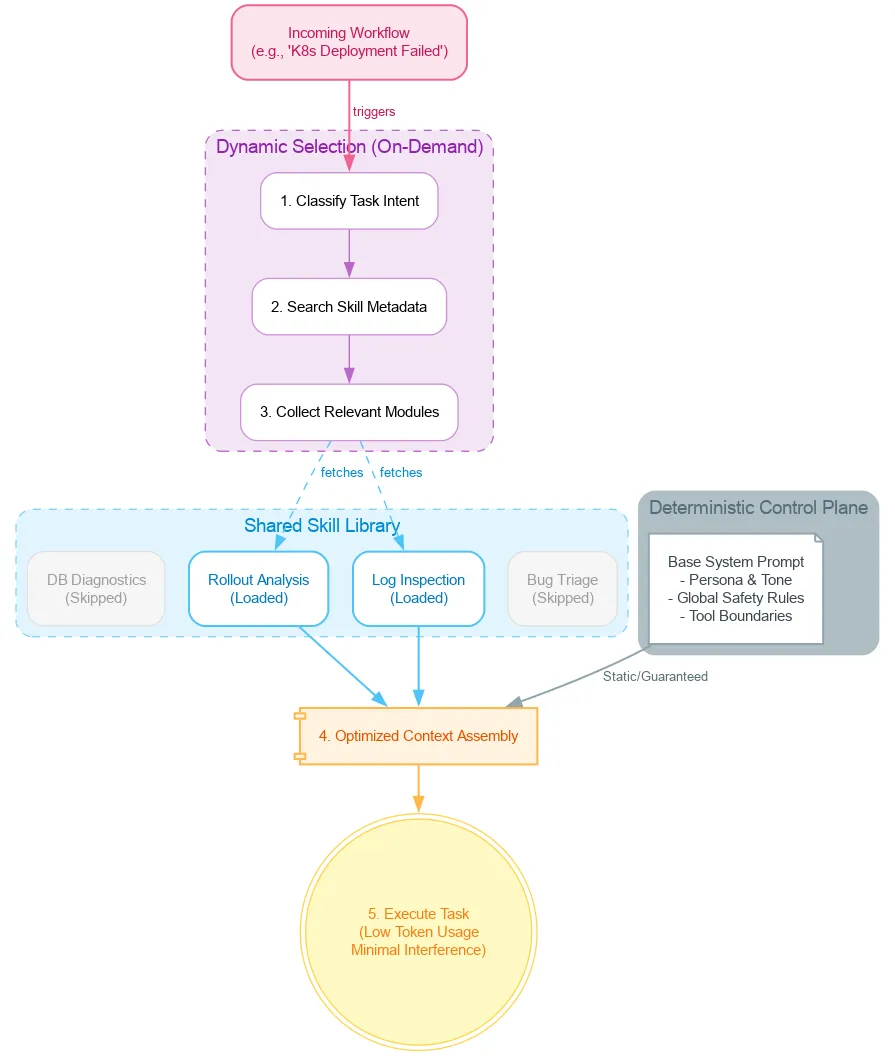
The stable control plane remains loaded while optional skills enter context only for relevant work. Source: Google Developers Blog.
This architecture needs precedence rules. A retrieved skill must not override the stable security layer. Each module should declare its owner, version, compatible agent types, required tools, and allowed policy scope. Runtime telemetry should record which modules were loaded for each consequential action.
Progressive disclosure also improves evaluation. A team can measure the base agent separately from the retrieval decision and the skill behavior. When quality drops, the failure can be classified as wrong skill selection, bad skill instructions, or model execution.
Agents may propose their own instructions, never merge them directly
Once skills are files, an agent can draft a module after resolving a new incident or discovering a missing procedure. That can turn operational experience into a reviewed code change rather than an ephemeral conversation.
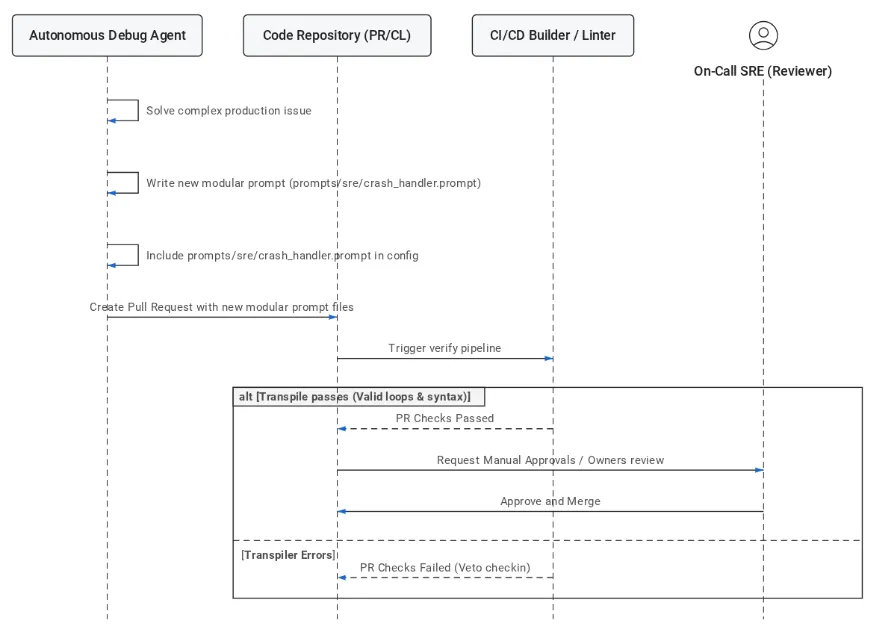
The agent proposes a source change; the same build, validation, evaluation, and human-review path determines whether it ships. Source: Google Developers Blog.
The agent must not rewrite its live control plane. It should open a pull request containing the source diff, reason for the change, affected modules, new tests, and evidence from the triggering run. CI rebuilds the artifact and runs the relevant eval suite. A human owner approves the release.
This is the same principle used for database migrations and infrastructure policy: automation can prepare a change, but production mutation crosses an independent gate.
A minimum implementation contract
Teams do not need a large platform to adopt the pattern. A small implementation can use Markdown or YAML modules, a real template engine, a dependency manifest, JSON Schema validation, and a CI command that emits rendered prompts into a versioned directory.
Every deployed agent version should expose:
- the rendered prompt hash;
- source-module versions;
- model and tool versions;
- build timestamp and commit;
- evaluation suite and results;
- approving owner;
- rollback target.
Tests should be selected by dependency impact. A change to shared PII policy needs broader regression coverage than a style update for one reporting skill. That requires mapping each eval set to the prompt modules and tools it protects.
Secret values should never be rendered into the prompt. Environment variables may select policies or endpoints, but credentials belong in the execution layer and should be injected only into authorized tool calls.
Prompt engineering is becoming release engineering
The value of transpilation is not clever templating syntax. It is moving errors and governance decisions from unpredictable model runtime into a deterministic software pipeline.
That shift becomes more important as agents gain write access, payment authority, or production tools. A model’s instructions are part of the security and reliability boundary. Teams should know exactly which instructions ran, how they were assembled, what changed, and which tests allowed the change to ship.
Prompts will remain probabilistic inputs to probabilistic models. Their deployment process does not have to be probabilistic too.
Build artifacts should be evaluated like any other agent output. The coding-agent evaluation framework measures accepted changes, GhostApproval exposes the authorization boundary, and the Google AI Studio URL review shows the lighter-weight deployment path this approach is meant to harden.