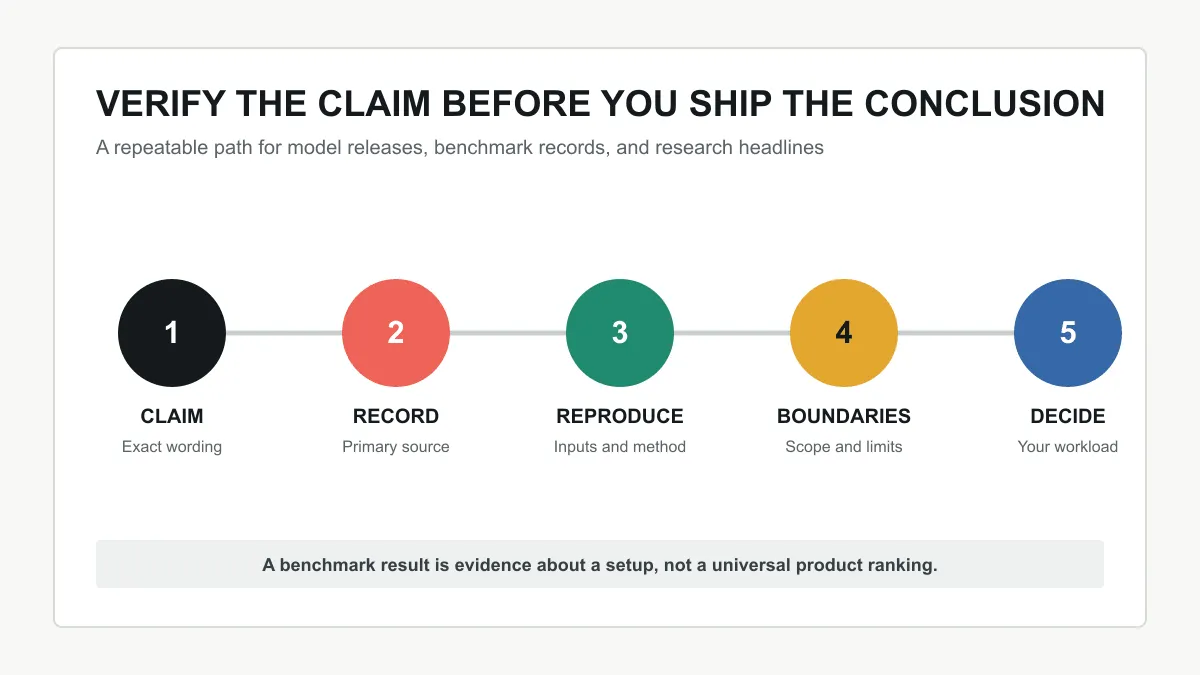
An AI release can be factually reported and still produce the wrong engineering decision. A model may lead a benchmark while using more test-time compute, win on an aggregate score while failing your highest-risk cases, or look cheaper before retries and tool calls are counted.
The solution is not to distrust every announcement. It is to evaluate each claim as evidence about a particular setup. The NIST AI Resource Center describes testing, evaluation, verification, and validation as an operational discipline rather than a one-time score. That is the right mental model for release coverage too.
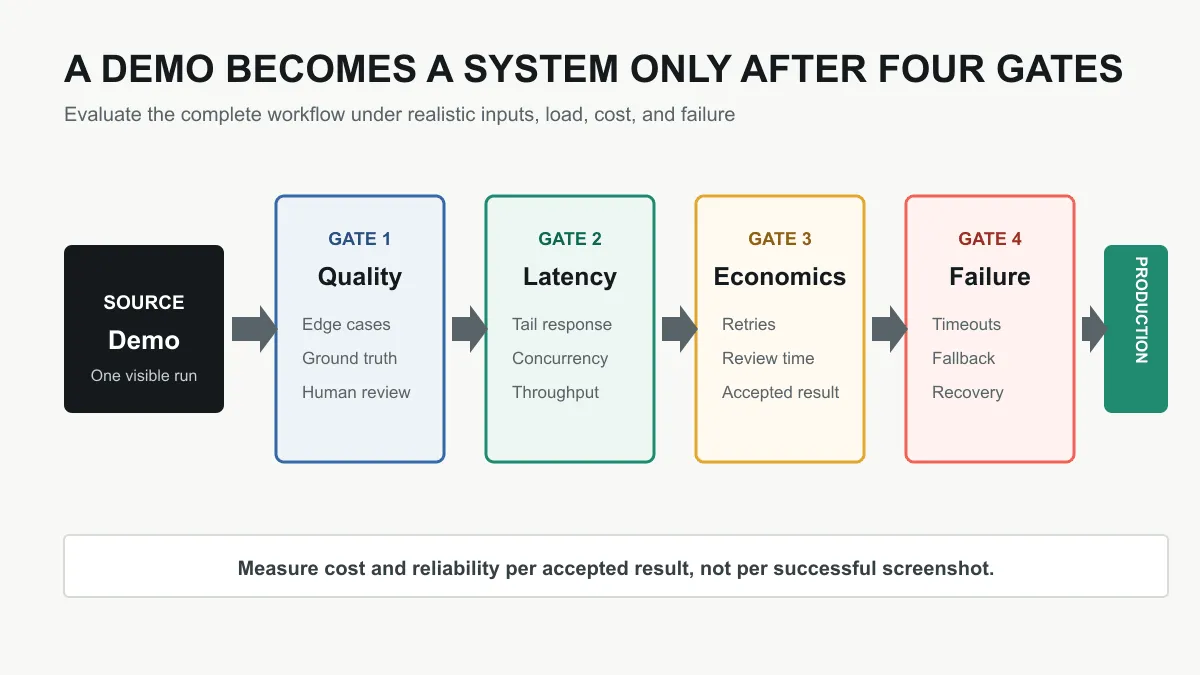
Figure: Verification continues after a successful model output. Quality, tail latency, total economics, and failure recovery determine whether the result transfers to production.
Use the following workflow whenever a headline contains a capability record, percentage improvement, benchmark rank, cost claim, or safety conclusion.
1. Rewrite the headline as a testable claim
Marketing language often combines several different claims. Separate them before checking the evidence.
| Claim type | What it sounds like | What must be specified |
|---|---|---|
| Capability | ”The model can solve advanced mathematics” | Task, success criterion, tools, attempt budget |
| Comparative quality | ”Model A beats Model B” | Dataset, scorer, versions, confidence interval |
| Cost | ”Ten times cheaper” | Input/output mix, caching, retries, tool usage |
| Latency | ”Real-time” | Hardware, region, concurrency, output length |
| Safety | ”More robust” | Threat model, attack budget, refusal trade-offs |
Replace broad wording with a sentence that could be disproved. Instead of “the best coding model,” write: “Under repository-level tasks from dataset X, with tool scaffold Y and a maximum budget of Z, the submitted system completed N percent of tasks.”
This step prevents a narrow result from silently becoming a universal ranking.
2. Find the primary record
Trace the claim to the artifact that created it: a model card, paper, benchmark submission, release note, repository, regulatory filing, or recorded product demonstration.
Do not stop at a social post that screenshots a chart. The chart may omit the denominator, footnote, evaluation date, or distinction between a base model and a complete agent system.
For research claims, record:
- The paper version and publication date.
- Author affiliations and disclosed conflicts.
- Dataset and evaluation code availability.
- Whether the result is peer reviewed, a preprint, or a company report.
- Whether the tested model is publicly accessible in the same configuration.
For product claims, record the exact model or service version. Silent backend updates can make a result impossible to reproduce a week later.
Our analysis of a claimed GPT-5.6 graph-theory result shows why this matters: the useful question is not whether the screenshot looked impressive, but whether a complete proof, independent verification, and stable model configuration exist. See GPT-5.6’s cycle double cover proof claim.
3. Reconstruct the evaluation setup
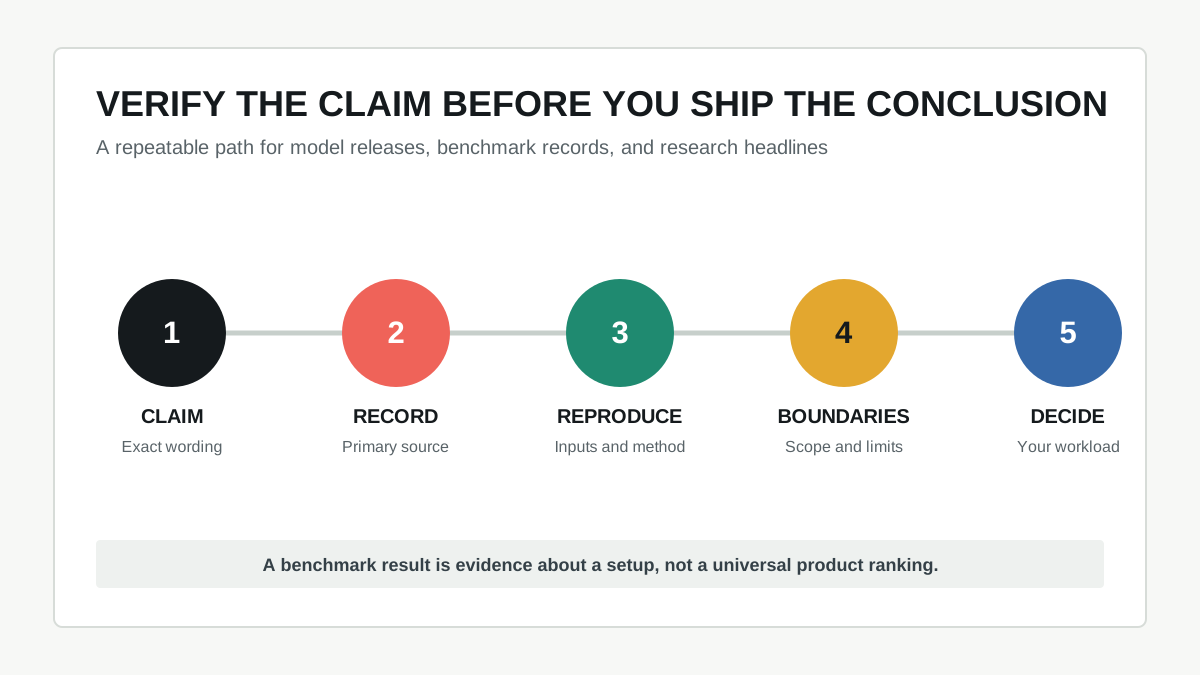
Figure: A consequential model claim should move from source recovery through reproduction and independent review before publication. Yield Signal Daily editorial diagram.
A score is downstream of many choices. Capture enough of them to understand what produced the result.
model/version:
system prompt:
tools and retrieval:
sampling parameters:
attempt and token budget:
dataset/version:
scorer and rubric:
hardware/region:
evaluation date:
Agent benchmarks deserve extra care because they measure the model plus scaffolding. File search, browser access, test execution, context management, retries, and human-written rules can change the result as much as the underlying model.
The same caution applies to reasoning settings. A model using a larger reasoning budget may improve quality while increasing latency and output tokens. Our GPT-5.6 configuration guide treats model choice and reasoning effort as separate controls for that reason.
If the original setup is unavailable, label the result as non-reproduced. That does not make it false. It limits how confidently it can be transferred to another environment.
4. Define the boundary of the evidence
Every evaluation has a scope. Write down who and what is outside it.
Dataset boundary
Public benchmarks can reward memorization, familiar task formats, or optimization against a known judge. A strong score may not transfer to private documents, unusual languages, long-running sessions, or organization-specific tools.
Statistical boundary
A point estimate without uncertainty invites false precision. Look for repeated runs, sample size, variance, confidence or credible intervals, and sensitivity to scoring choices.
Operational boundary
An API evaluation may ignore rate limits, regional availability, cold starts, moderation behavior, and failure recovery. A local-model demo may omit memory pressure, sustained throughput, and hardware cost.
Causal boundary
An association is not automatically an intervention effect. The Microsoft coding-agent study found more merged pull requests among adopters but explicitly used merged PRs as a proxy for output, not a universal measure of productivity. Our study analysis explains the difference.
Time boundary
Fast-moving products age quickly. Preserve the evaluation date and re-check critical claims before a procurement or architecture decision.
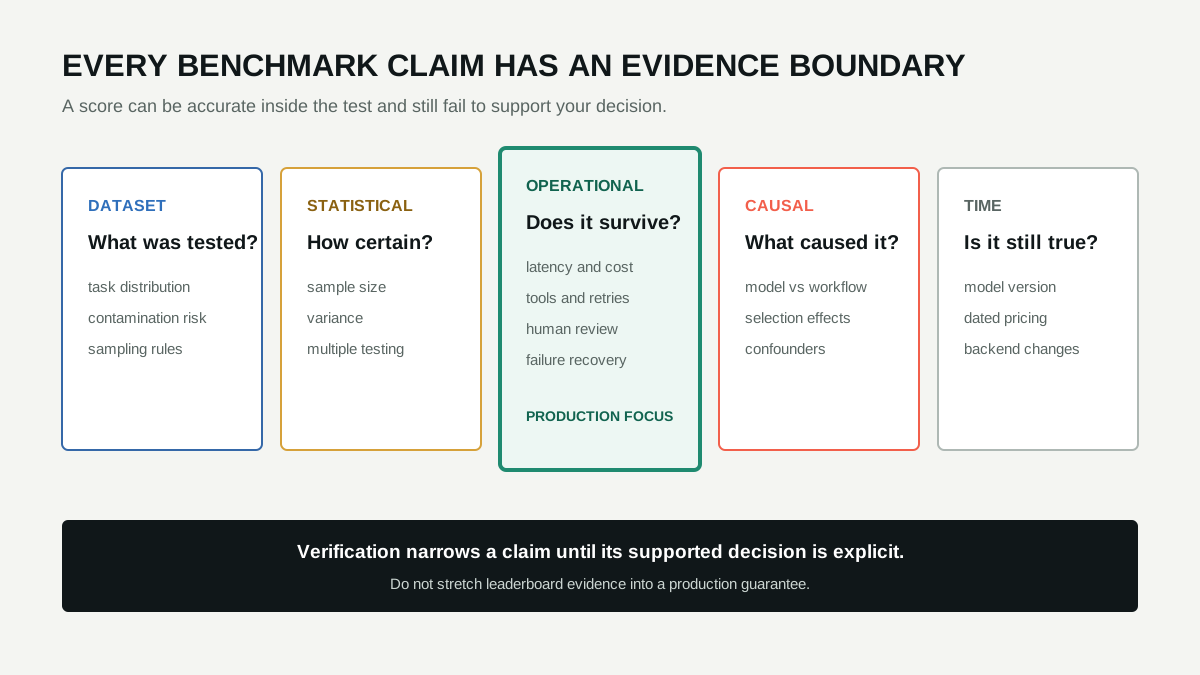
Figure: Dataset, statistical, operational, causal, and time boundaries must all be explicit before a benchmark result supports a production decision. Yield Signal Daily editorial diagram.
5. Run a workload decision test
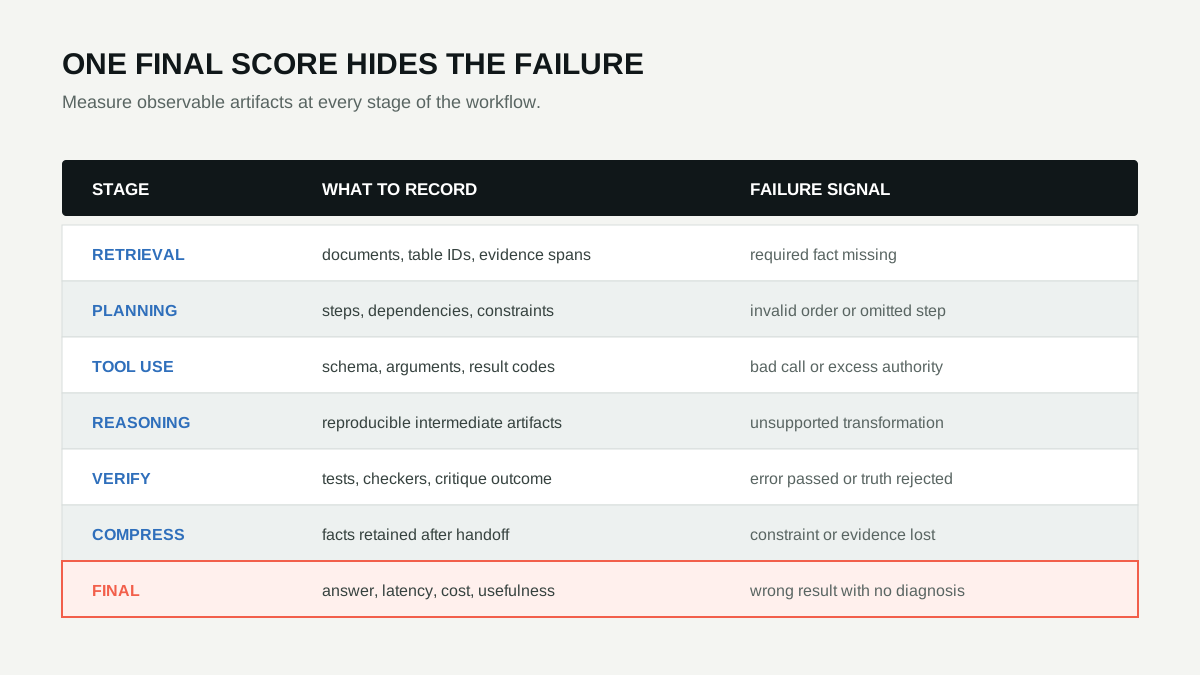
Figure: Stage-level evaluation turns one final score into signals for retrieval, planning, execution, verification, and compression. Yield Signal Daily editorial diagram.
The final question is not “Did the model win?” It is “Does this evidence justify a change in our system?”
Build a small evaluation set from real work. Include common cases, expensive cases, and failure cases that carry business or safety risk. Keep the acceptance criteria stable across candidates.
Measure at least four dimensions:
- Task success: Did the output meet a human-defined acceptance test?
- Reliability: How often did retries, malformed output, or tool failures occur?
- Latency: What were median and tail response times under realistic concurrency?
- Economics: What was the total cost per accepted result, including retries and review?
For high-impact workflows, add security, privacy, and recovery tests. A higher average quality score does not compensate for an unacceptable data boundary or an unrecoverable action.
A compact publication checklist
Before publishing or sharing a model claim, answer these questions:
- Can a reader identify the exact claim and original source?
- Are the model, scaffold, dataset, scorer, and budget named?
- Is the result independently reproduced, source-reported, or only demonstrated?
- Are uncertainty, conflicts, and missing artifacts disclosed?
- Does the headline stay inside the evidence boundary?
- Is analysis clearly separated from confirmed fact?
- Is there a practical next test for the reader?
If three or more answers are “no,” the story is still a lead, not a verified engineering conclusion.
What good verification produces
Verification does not eliminate uncertainty. It makes uncertainty legible.
A useful article should leave readers knowing what happened, who measured it, how it was measured, what remains unknown, and whether the result matters for their workload. That standard creates slower conclusions than a screenshot-driven feed, but it produces decisions that survive the next model release.