The verdict: Kimi K3 is a serious frontier-model release, but the 2.8-trillion-parameter headline is not the main reason developers should care. The important parts are its extreme sparsity, long-context agent design, native visual input, and evidence that an open model can compete in expensive engineering workflows. The catch is that the same architecture is difficult to serve, sensitive to its agent harness, and not yet practical for most teams to self-host.
Moonshot AI released Kimi K3 on July 16 across Kimi.com, Kimi Work, Kimi Code, and its API. The company says full weights will arrive by July 27. As of July 22, developers can test the hosted product, but an independently deployable release and the promised technical report are still pending.
This is therefore neither a victory lap nor a dismissal. K3 has earned a production evaluation. It has not earned an automatic migration.
What Moonshot actually released
Kimi K3 is a 2.8T-parameter mixture-of-experts model with native vision and a context window of 1,048,576 tokens. It is built around Kimi Delta Attention, Attention Residuals, and a Stable LatentMoE system that activates only 16 of 896 experts for each token.
That makes the model unusually sparse: about 1.8% of its routed experts participate in a token’s forward path. Total parameters describe storage and capacity; active routing is closer to the compute story. Moonshot says the architecture delivers about 2.5 times better scaling efficiency than Kimi K2, although that remains a vendor claim until the technical report and independent reproductions arrive.
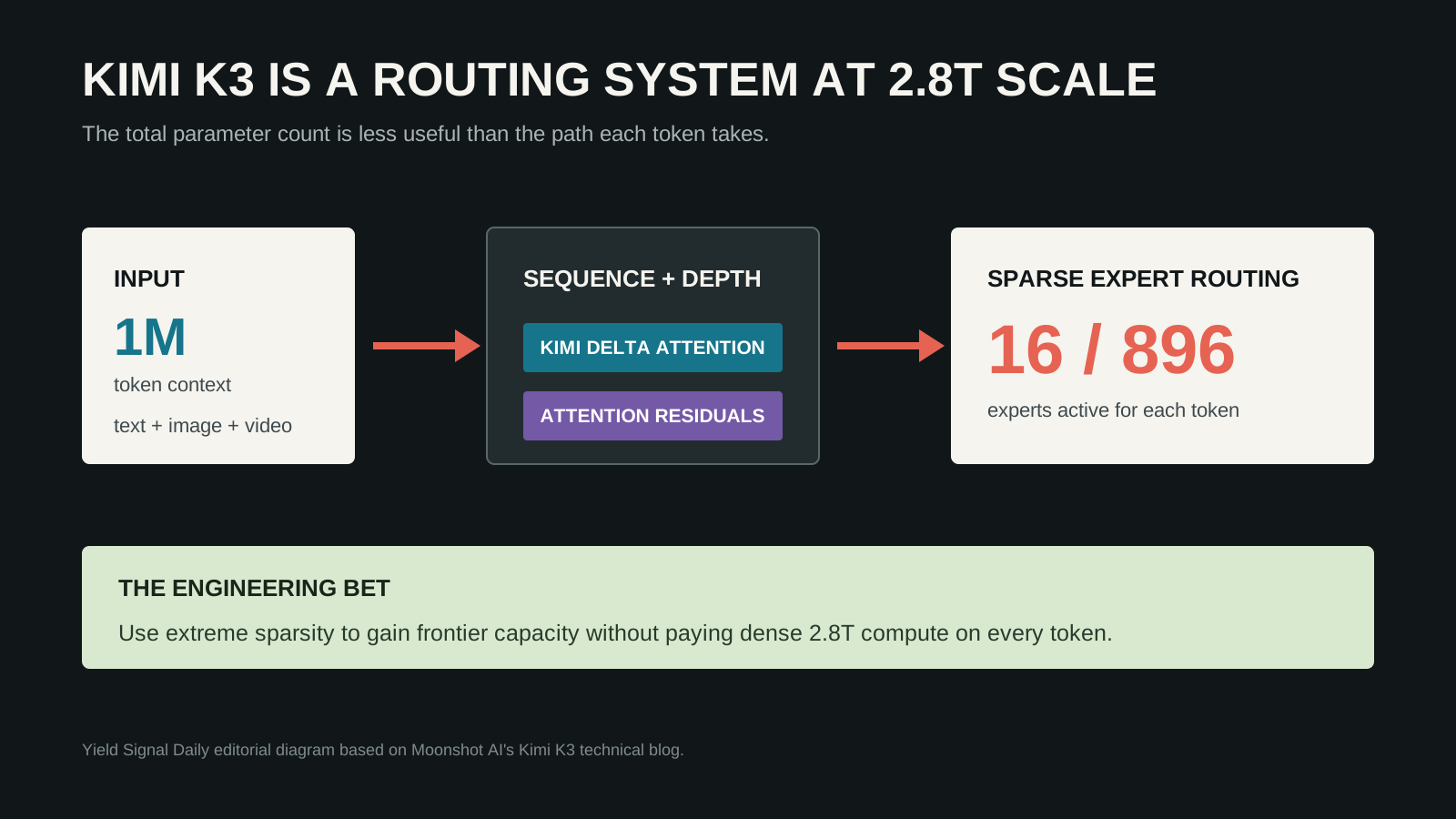
Figure: K3’s engineering bet is not dense 2.8T inference. It is efficient sequence processing followed by highly sparse expert routing. Yield Signal Daily editorial diagram based on Moonshot AI’s technical blog.
The architecture also explains why K3 is pitched as more than a chat model. Moonshot targets long coding sessions, large repositories, terminal orchestration, game and 3D development, scientific computing, and visual feedback loops. Kimi Code can send images and video to the model, expose multiple reasoning-effort settings, and coordinate subagents.
The benchmark story is strong but not simple
Moonshot’s coding table places K3 near or above leading proprietary models on several agentic evaluations. The company reports a 67.3 score on DeepSWE with the mini-SWE-agent harness and strong results on Terminal-Bench 2.1, FrontierSWE, Program Bench, SWE Marathon, and its internal Kimi Code Bench.
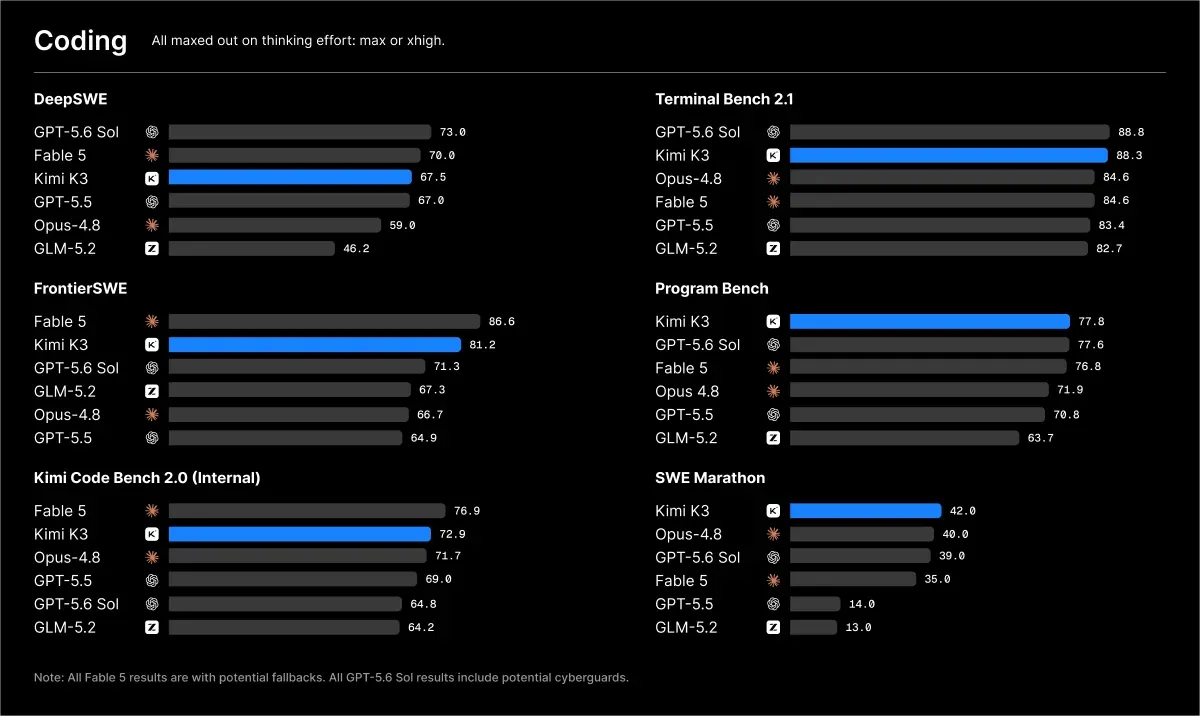
Figure: Moonshot’s official coding benchmark comparison. Results use different agent harnesses depending on the model and should not be read as a single controlled model-only comparison. Source: Moonshot AI.
The caveat is in Moonshot’s own footnotes. K3 is evaluated with KimiCode or Claude Code depending on the benchmark. Other models use Claude Code, Codex, Terminus, or published leaderboard results. Claude Fable 5 reportedly hit fallback behavior on 35% of Moonshot’s SWE Marathon tasks. Some evaluations ran on an H20-calibrated branch rather than the original hardware setting.
None of that invalidates the results. It means the harness is part of the product. Tool schemas, context compaction, retry behavior, shell recovery, permissions, and the way hidden reasoning history is returned can materially change task success. A leaderboard labeled by model name can still be measuring a model-runtime pair.
Independent evidence is encouraging but narrower. Arena reported K3 at the top of its frontend-coding ranking after launch. That supports the claim that K3 is exceptionally capable at visual web work; it does not prove superiority across backend maintenance, production incidents, or private repositories.
Its biggest advantage may be work per dollar
The official API lists K3 at $0.30 per million cache-hit input tokens, $3 per million uncached input tokens, and $15 per million output tokens. That is significantly more expensive than Kimi K2.7 Code, but still aggressive for a model positioned near the proprietary frontier.
Moonshot’s own BrowseComp chart makes the commercial argument directly: K3 reaches a high score at a much lower estimated cost per task than several competing models.
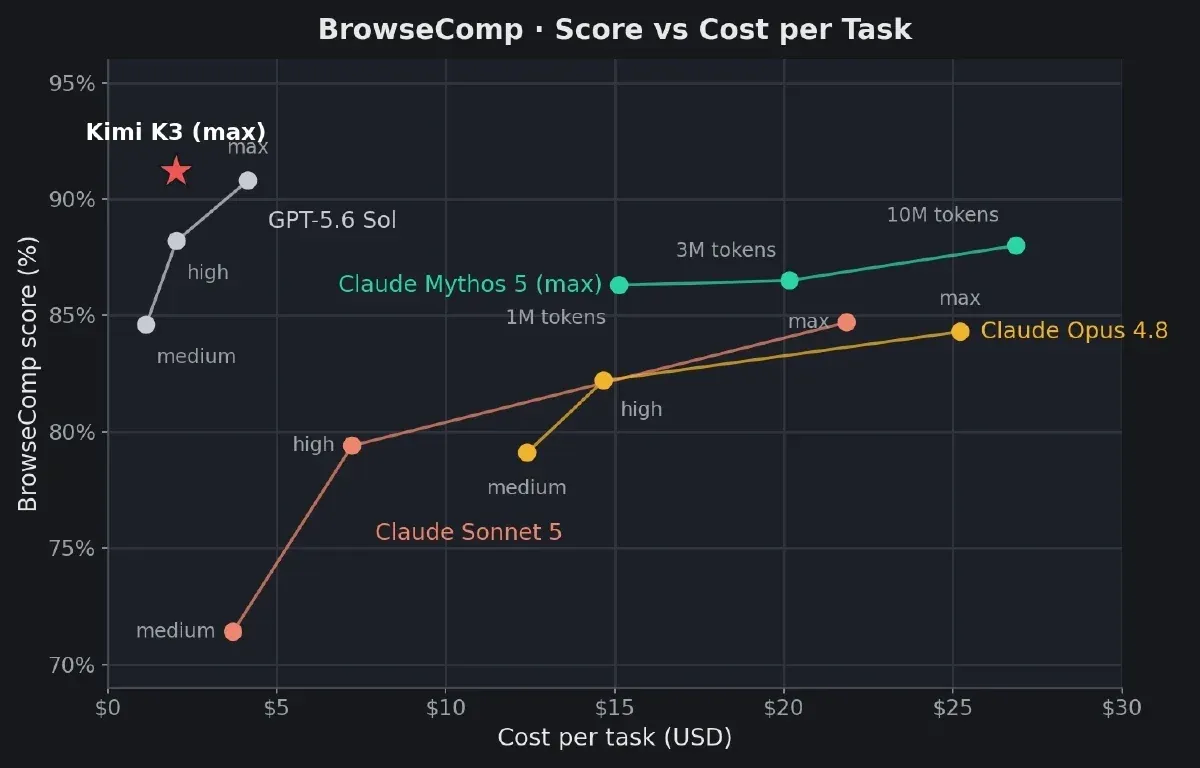
Figure: Moonshot’s BrowseComp comparison plots model score against estimated cost per task. It is useful for forming a hypothesis, not a substitute for measuring a real workload. Source: Moonshot AI.
Token price is still not task price. K3 reasons by default, agent workflows make repeated calls, and long contexts can turn one failed run into an expensive run. Cache behavior is central: switching models or reasoning effort invalidates the current prompt cache, according to the Kimi Code changelog. A team that constantly changes models may never realize the advertised cached-input economics.
The production metric should be successful work per dollar:
effective task cost =
  input + output + retries + tool runtime + review time + regression cost
K3 wins only when the full number drops, not when its token row looks cheaper.
Open weights will not make this a laptop model
Moonshot recommends supernode configurations with at least 64 accelerators for K3 deployment. Extreme MoE sparsity saves arithmetic, but the complete model still has to be stored and routed. Expert parallelism requires high-bandwidth communication, balanced routing, stable static shapes, cache support for KDA, and operational tooling around a very large distributed system.
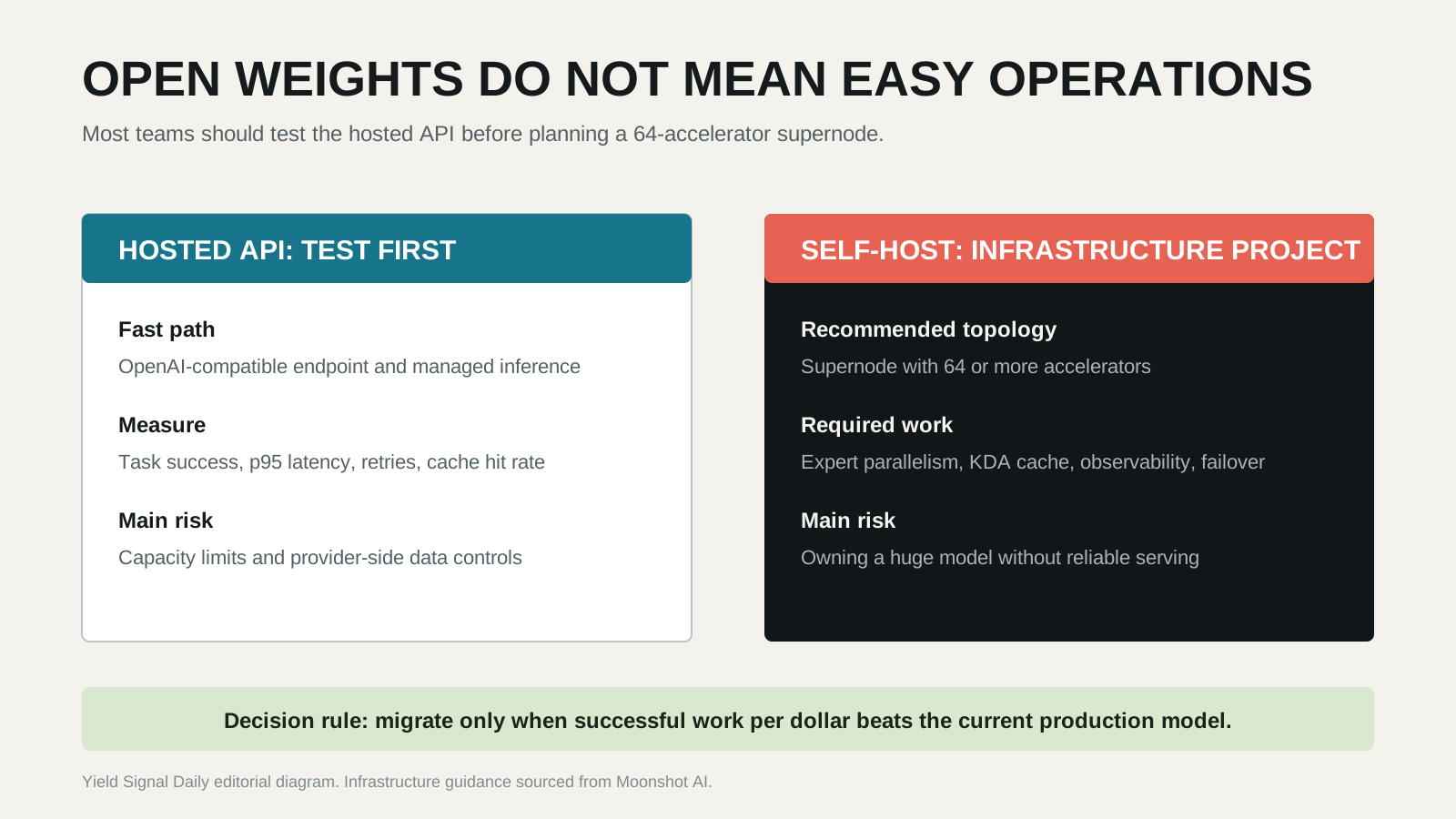
Figure: Open weights improve control and portability, but K3-scale self-hosting remains an infrastructure program. Yield Signal Daily editorial diagram based on Moonshot’s deployment guidance.
For most startups, the rational first test is the hosted API. Self-hosting becomes interesting for organizations that already operate large accelerator clusters, need strict data residency, have sustained utilization, and can support a dedicated inference team. Everyone else risks trading provider dependence for a fragile cluster they cannot keep efficient.
The launch’s capacity problem reinforces that point. Reuters reported that Moonshot temporarily paused new subscriptions after demand approached the limits of its clusters. Existing paid users were prioritized while the company added capacity. A model can be computationally efficient relative to its size and still be costly to serve at internet scale.
The limitations are unusually actionable
Moonshot discloses that K3 is sensitive to thinking history. If a harness does not return the preserved reasoning history in the format the model expects, quality can become unstable. Switching an existing session from another model to K3 can cause the same problem. The company recommends starting a new session and using a verified harness such as Kimi Code.
That warning deserves more attention than another benchmark bar. It implies three deployment checks:
- Verify the exact message and reasoning-history contract used by the client.
- Test compaction and session resume across multiple long tasks.
- Compare fresh-session performance with model-switched and recovered sessions.
K3 should also be tested under failure: denied tool permissions, timeouts, malformed tool output, stale repository state, partial terminal results, and an operator interrupt. Long-horizon autonomy is useful only when the system can be observed and stopped.
A seven-day developer evaluation
Do not begin with trivia, one-shot code generation, or a synthetic landing page. Build a shadow evaluation from real work:
- Select 20 versioned tasks from repositories your team understands.
- Include cross-file features, bug fixes, test repair, dependency migration, and visual frontend work.
- Run K3 and the current model with equivalent tools, permissions, and time budgets.
- Record pass rate, unnecessary edits, retry count, p50 and p95 completion time, token cost, and human correction time.
- Force two sessions through context compaction and one through recovery after an interrupted command.
- Review privacy, retention, regional storage, subprocessors, and deletion terms before sending private code.
- Route only the task classes where K3 produces a repeatable advantage.
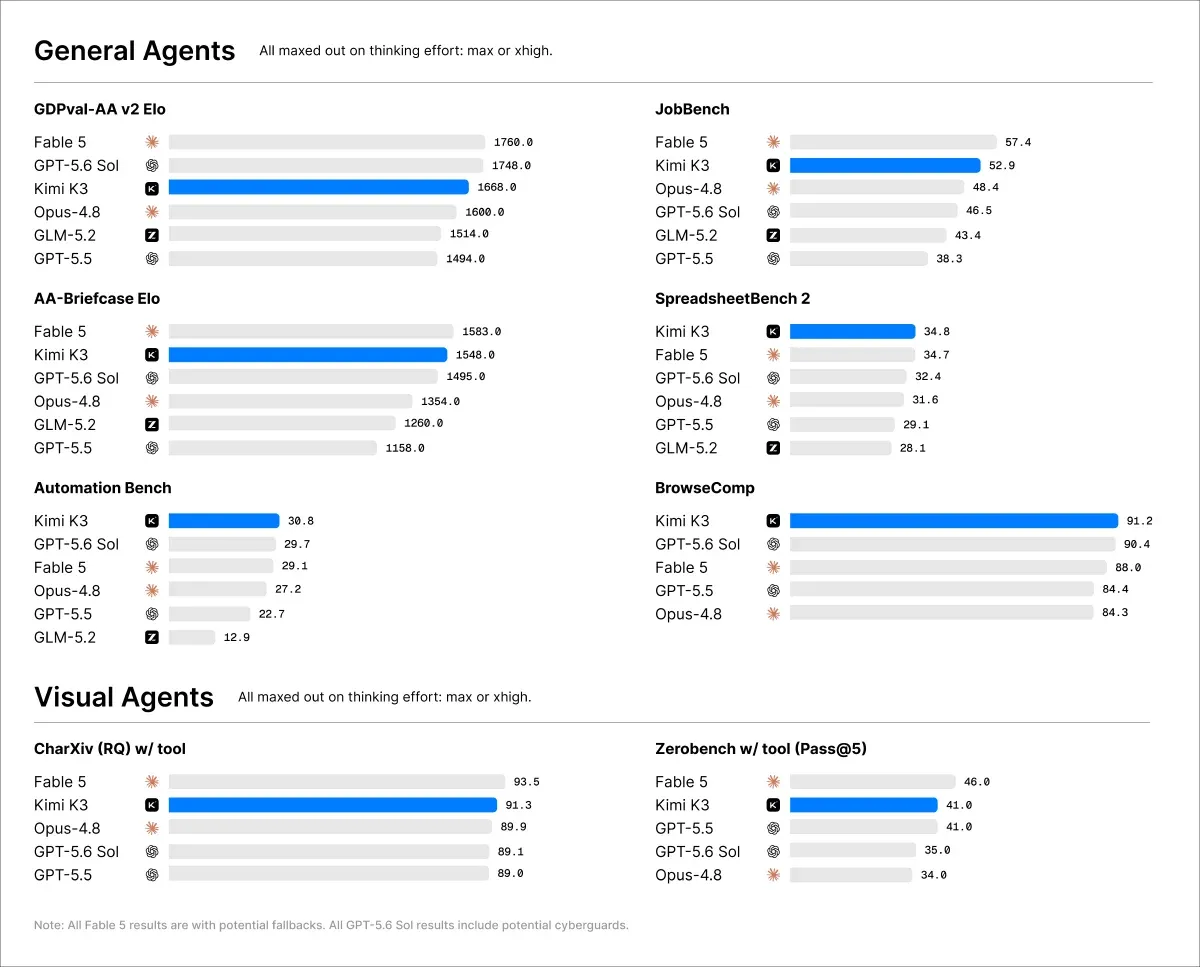
Figure: Moonshot reports broad agent gains beyond coding, including automation, spreadsheet, research, and visual tasks. These results are a useful test map for an independent evaluation. Source: Moonshot AI.
This process may produce a mixed answer. K3 could become the preferred model for frontend iteration and research while another model remains better at repository discipline or incident recovery. Model routing is often more rational than model loyalty.
K3 changes the open-model ceiling, not the laws of production
Kimi K3 is important because it combines frontier-scale capacity, a credible agent stack, native multimodality, long context, and aggressive API pricing in a model promised for open-weight release. It also demonstrates how much of modern model performance now lives outside the checkpoint: harness design, tools, cache behavior, subagents, and serving infrastructure.
The next decisive event is not another screenshot. It is the July 27 weight release and technical report. Developers should inspect the license, checkpoint formats, quantization support, vLLM integration, memory requirements, and whether third parties can reproduce both quality and throughput.
Until then, the right conclusion is measured: K3 belongs in the evaluation queue immediately. It does not belong in production merely because 2.8 trillion is a large number.
The release should be tested, not admired from its model card. Start with the five Kimi K3 developer tests, compare serving constraints with the Qwen 397B TPU optimization, and use the GPT-5.6 routing guide as a closed-model baseline.